

Teen Anxiety Treatment: Why Professional Help is the Right Choice
Medical Disclaimer: The content provided in this article is for informational purposes only and does not constitute medical advice. If your teen is experiencing severe anxiety, panic attacks, or expressing suicidal thoughts, please call 988 or go to the nearest emergency room immediately. For confidential assessment and admissions, contact Teen Mental Health Facility.
Introduction: When "Don't Worry" Isn't Enough
As a parent, your instinct is to protect your child from pain. When they are anxious, you want to fix it. You tell them, “It’s going to be okay,” or “Just take a deep breath.”
But what happens when the reassurance stops working?
What happens when your teen is paralyzed by fear before school every morning? What happens when they stop seeing friends because social situations feel like a minefield? What happens when they are having panic attacks that leave them gasping for air on the bathroom floor?
This is the reality for millions of families. Anxiety is the number one mental health issue facing adolescents today. And for many teens, it isn’t just “stress”; it is a debilitating medical condition that requires professional intervention.
At Teen Mental Health Facility, we understand that making the decision to seek treatment is terrifying. You might feel like you’ve failed. You might worry about the stigma.
In this comprehensive guide, we will validate your struggle, explain the science of teen anxiety, and show you why choosing a specialized facility isn’t “giving up”—it’s the most powerful way to fight for your child’s future.
If you are ready to break the cycle of fear, explore our Teen Anxiety Treatment Programs.
The Science: Why Teens Are So Vulnerable
To understand why your teen can’t just “calm down,” you have to understand their brain.
Adolescence is a “perfect storm” for anxiety.
- The Amygdala (Emotion): This part of the brain is fully developed and hyper-reactive. It perceives social rejection or academic failure as a life-or-death threat.
- The Prefrontal Cortex (Logic): This part, responsible for calming the Amygdala, is under construction until age 25.
The Mismatch: Your teen has a gas pedal (fear) that is floored, and brake pads (logic) that haven’t been installed yet. They literally lack the biological hardware to self-regulate intense anxiety without help.
Signs It Has Crossed the Line
How do you know if it’s “just high school stress” or an Anxiety Disorder? Look for Functional Impairment.
- Avoidance: They stop doing things they used to love (sports, parties) because of fear.
- Physical Sickness: Frequent headaches, stomach aches, or nausea, especially on Sunday nights or Monday mornings.
- Sleep Disruption: Staying awake until 3 AM because they can’t turn off the racing thoughts.
- Perfectionism: A meltdown over a B+ or a minor mistake. This is not ambition; it is terror.
Why "DIY" Treatment Fails
Many parents try to manage teen anxiety at home. You might:
- Allow them to stay home from school (“Mental Health Days”).
- Accommodate their fears (ordering for them at restaurants).
- Try to be their therapist.
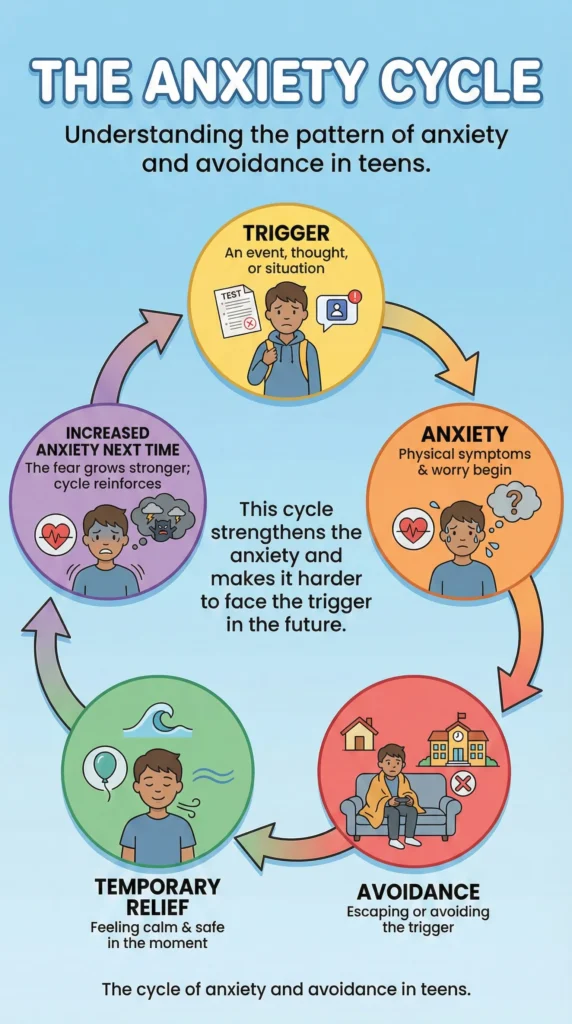
The Trap of Accommodation: While well-intentioned, these behaviors often make anxiety worse. When you help your teen avoid a scary situation, their anxiety goes down temporarily (Relief). But their brain learns: “I was right. That situation WAS dangerous, and I can’t handle it.” The next time, the anxiety is stronger.
Why Professional Treatment Works: We do the opposite. We use Exposure Therapy. In a safe, controlled environment, we help your teen face their fears in small steps. We teach their brain: “I can handle this. I am safe.”
The Benefits of a Specialized Teen Facility
Why choose a facility like Teen Mental Health Facility over a local therapist?
1. Immersion Therapy (Breaking the Pattern)
Anxiety is often reinforced by the environment (school pressure, family dynamics, social media). By entering a Partial Hospitalization Program (PHP) or Residential Treatment, your teen is removed from the triggers. They get a “nervous system reset.” They are surrounded 24/7 by therapeutic support, allowing them to learn skills faster than they could in a weekly 50-minute session.
2. Peer Validation
Teens listen to peers more than adults. In our group therapy sessions, your teen will sit with other kids who look just like them—smart, cool, normal kids who also have panic attacks. The Breakthrough: “I’m not crazy. I’m not alone.” This shame-reduction is half the battle.
3. A Multi-Disciplinary Team
Anxiety is complex. It requires a village. Our team includes:
- Psychiatrists: To manage medication if needed.
- Therapists: To teach CBT and DBT skills.
- Academic Liaisons: To ensure they don’t fall behind in school (a huge source of anxiety).
- Family Therapists: To teach you how to support them without enabling the anxiety.

What Treatment Actually Looks Like
It isn’t scary. It isn’t a hospital ward. It looks like a school for emotional intelligence.
Cognitive Behavioral Therapy (CBT): We teach teens to catch their “Automatic Negative Thoughts” (ANTs).
- Thought: “If I fail this test, I’ll never get into college and I’ll be homeless.”
- Challenge: “Is that true? Or is that catastrophic thinking?”
Dialectical Behavior Therapy (DBT): We teach “Distress Tolerance.” How to survive a panic attack without self-harming or spiraling. We use sensory tools (ice, sour candy, weighted blankets) to hack the nervous system.
Family Systems Work: We work with you. We teach you the difference between Support (empowering them to face fear) and Enabling (protecting them from fear). We give you scripts to use when they are spiraling.
Case Study: Emily’s Courage
The Crisis: Emily, 16, was a straight-A student who suddenly refused to go to school. She was vomiting every morning from anxiety. Her parents tried everything—bribes, punishment, pleading. Nothing worked.
The Intervention: Emily entered our Teen Mental Health Facility PHP.
- Week 1: Stabilization. She learned that her physical symptoms were panic, not the flu.
- Week 3: Exposure. She practiced walking into a classroom setting (in our facility) while using breathing skills.
- Week 6: Reintegration. She returned to her school for half-days, supported by our team.
The Result: Emily is back in school full-time. She still gets anxious, but she knows what to do with it. She has her life back.

Conclusion: The Best Investment You Can Make
You save for their college. You pay for their braces. Investing in their mental health is the most important investment of all.
If your teen cannot function because of anxiety, the best grades in the world won’t matter. By choosing professional treatment, you are giving them a toolkit they will use for the rest of their lives. You are teaching them that they are worth fighting for.
You don’t have to navigate this storm alone. We are here to help.
If you are ready to see your child smile again, contact Teen Mental Health Facility today.
Frequently Asked Questions
Will my teen fall behind in school? No. Our programs include dedicated academic time and coordination with their home school. Often, addressing the anxiety improves their grades because their brain is no longer in “fight or flight” mode during class.
Do you use medication? We believe in a holistic approach. Medication is a tool, not a crutch. For some teens, a temporary course of SSRIs can lower the “noise” of anxiety enough for therapy to work. This is always a decision made with the parents and psychiatrist.
What if they refuse to go? This is common. Anxiety tells them that avoiding treatment is safer. We can coach you on how to have the conversation firmly and lovingly. Sometimes, parents have to be the “Prefrontal Cortex” and make the executive decision for safety.
Is this expensive? Most private insurance plans (PPO) cover mental health treatment (PHP/IOP) as a medical necessity. We can verify your benefits for free.