

Medical Disclaimer: The content provided in this article is for informational purposes only and does not constitute financial, legal, or medical advice. Health insurance policies, coverage limits, and medical necessity criteria vary significantly by provider and plan. If your teen is experiencing a life-threatening mental health emergency, severe panic, or active suicidal ideation, please call 988 or go to the nearest emergency room immediately. For a free, confidential verification of your specific insurance benefits, contact the admissions team at Teen Mental Health Facility.
Introduction: The Financial Wall Between You and Your Child’s Future
When a parent realizes that their teenager is in the midst of a severe mental health crisis, the world seems to stop spinning.
You have watched the signs accumulate. You have seen the vibrant, engaged child you raised slowly retreat behind a locked bedroom door. You have witnessed the plummeting grades, the explosive irritability, the sudden isolation, or the terrifying discovery of self-harm scars. You have finally pushed past the denial, made the brave decision to stop “waiting for it to pass,” and committed to finding professional, clinical help.
You find a reputable treatment center. You read about their specialized teen programs, their evidence-based therapies, and their compassionate staff. You feel a desperate, fragile spark of hope that you might actually get your child back.
And then, almost instantly, that hope is crushed by a towering wall of panic:
“How on earth are we going to pay for this?”
When parents look at the prospect of intensive mental health treatment for their adolescent, they often assume it is a luxury reserved strictly for the ultra-wealthy. You worry about draining the college fund, taking out a second mortgage, or destroying your family’s financial stability just to keep your child safe.
At Teen Mental Health Facility, we want you to take a deep breath. That fear is based on a myth.
The idea that high-quality, comprehensive teen mental health treatment is inaccessible to the average working family is simply untrue. In reality, the vast majority of adolescents receiving top-tier clinical care are doing so by utilizing their parents’ private health insurance benefits.
In this comprehensive guide, we are going to dismantle the confusing, intimidating world of behavioral health insurance. We will explain your powerful legal rights, decode the insurance jargon in plain English, and show you exactly how to leverage your policy to get your teenager the life-saving care they deserve.
If you want to skip the reading and find out exactly what your policy covers right now, explore our free, no-obligation Insurance Verification at Teen Mental Health Facility.

Section 1: The Law is on Your Side (The Parity Act)
Insurance companies often rely on the fact that their customers do not know their rights. As a parent, you have immense, federally protected legal rights regarding your child’s mental health care.
Historically, health insurance companies treated mental health and substance abuse as “secondary” or “elective” issues. They would happily pay tens of thousands of dollars for a teenager’s sports injury, asthma treatment, or appendectomy, but they would place severe caps on therapy sessions or refuse to cover intensive outpatient programs for severe depression entirely.
That discriminatory practice is now illegal.
The Mental Health Parity and Addiction Equity Act (MHPAEA) is a federal law enacted to close this gap. It dictates that private health insurance companies must cover mental health and substance use disorder treatment at the exact same level they cover physical medical and surgical procedures.
- What this means for your teen: If your health plan covers a hospital stay or intensive physical therapy for a broken leg, it is legally required to cover a medically necessary Partial Hospitalization Program (PHP) for severe anxiety, trauma, or self-harm. Your copays, deductibles, and out-of-pocket maximums for mental health cannot be more restrictive than those for physical health.
You are not asking your insurance company for a favor. You are utilizing a legally protected benefit that you have paid premiums for every single month.
Section 2: Decoding the Financial Jargon
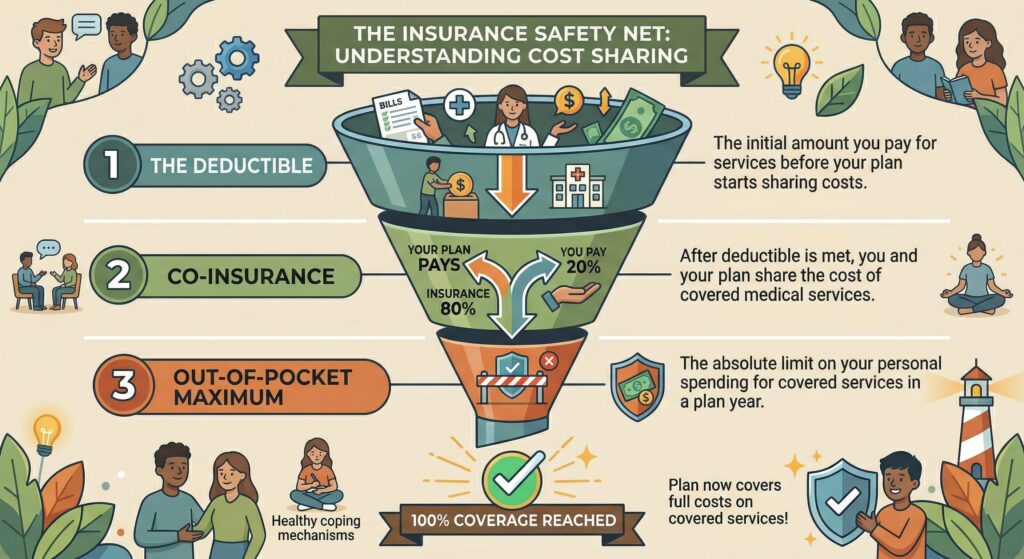
If insurance is required to cover treatment, why do some families still receive medical bills? To avoid “sticker shock” and understand what you will actually owe out-of-pocket, you must master three critical insurance terms. Once you understand these, the financial fear often disappears.
1. The Deductible
This is the baseline amount of money you must pay out of your own pocket for healthcare services before your insurance company starts paying for anything.
- The Reality: If your family’s annual deductible is $2,500, you are responsible for the first $2,500 of your teen’s treatment costs. Because deductibles reset annually, many families have already met a significant portion of this through regular pediatrician visits, urgent care trips, or prescriptions earlier in the year.
2. Co-Insurance
Once you have met your deductible, you do not immediately get 100% free healthcare. You and the insurance company split the remaining costs based on a pre-determined percentage.
- The Reality: If you have an “80/20 plan,” it means the insurance company pays 80% of the daily clinical rate for your teen’s program, and you are responsible for paying the remaining 20% (your co-insurance).
3. The Out-of-Pocket Maximum (OOPM)
This is your ultimate financial safety net. Your OOPM is the absolute highest amount of money your family will be legally required to pay in a single calendar year for covered medical services.
- The Reality: If your family OOPM is $6,000, once your combined deductibles and co-insurance payments hit that mark, your insurance steps in and pays 100% of all covered medical services for the rest of the year.
The Silver Lining of Intensive Care: Because intensive teen mental health treatment is a front-loaded medical expense, families frequently hit their Out-of-Pocket Maximum within the first few weeks of an intensive program. Once that threshold is crossed, months of ongoing step-down therapy and psychiatric care for your teen are often fully covered.
Section 3: PPO vs. HMO (Navigating Your Specific Plan)
The type of care your teen can easily access largely depends on the structural type of insurance policy you hold through your employer or the marketplace.
PPO (Preferred Provider Organization)
If you hold a PPO plan (such as Anthem Blue Cross, Aetna, UnitedHealthcare, or Cigna), you possess the “gold standard” for treatment flexibility.
- Out-of-Network Benefits: PPO plans typically allow you to seek care outside of their specific, limited corporate network. This means you can choose a premium, highly specialized facility like Teen Mental Health Facility. Even if we are not directly “in-network” with your insurer, your PPO plan will still cover a significant percentage of your teen’s clinical care. This gives you the freedom to choose a program based on clinical excellence, safety, and cultural fit, rather than just settling for whatever sterile clinic is on an insurance roster.
HMO (Health Maintenance Organization)
HMO plans (such as Kaiser Permanente) are much more restrictive by design.
- The Network Trap: HMOs require you to stay strictly within their pre-approved network of doctors and facilities. If you go out of network, the HMO will generally pay zero dollars. While staying in-network often results in lower out-of-pocket costs initially, it drastically limits your choices. You may face long wait lists to get your teen into therapy, or they may be placed in overcrowded, generic group settings that lack specialized trauma or dual-diagnosis care.
- Single Case Agreements (SCA): If your HMO cannot provide the highly specialized care your teen needs within their network (for example, intensive DBT for severe self-harm), clinical facilities can sometimes negotiate a Single Case Agreement. This forces the HMO to cover your teen’s stay at an out-of-network facility due to a lack of adequate in-network resources.
Section 4: What Levels of Care Does Insurance Cover?
When looking at mental health treatment, your insurance does not just write a blank check for “rehab.” They authorize specific levels of care based on the severity of your teen’s clinical symptoms and the medical necessity of the intervention.
At Teen Mental Health Facility, we operate at the precise levels of care that insurance companies recognize as intensive medical necessities:
Partial Hospitalization Program (PHP)
- What it is: Often referred to as “Day Treatment.” Your teen attends intensive clinical programming (psychiatry, evidence-based group therapy, and academic support) for a full school day (typically 6 hours a day, 5 days a week), but sleeps safely at home.
- Insurance Coverage: Highly covered. PHP is incredibly cost-effective for insurance companies because it removes the massive overhead cost of overnight hospital “room and board,” while still delivering the intense clinical intervention required to stabilize severe depression, school refusal, or active suicidal ideation.
Intensive Outpatient Program (IOP)
- What it is: A step-down level of care where your teen attends therapy for roughly 3 hours a day, 3 to 4 days a week, usually after school hours.
- Insurance Coverage: Widely covered as a necessary transition phase. Insurance providers prefer IOP because it allows the teen to practice their new coping skills in their real high school environment while maintaining a strong clinical safety net, significantly reducing the risk of a future crisis or re-hospitalization.
Explore how these programs integrate into your teen’s life on our Treatment Programs Page.

Section 5: The “Medical Necessity” Battle (And How We Fight It)
You might be wondering, “If federal law says they have to cover it, why do I hear stories of families getting denied coverage or cut off early?”
The answer lies in Utilization Review (UR). Insurance companies operate as businesses. They do not want to pay for months of treatment if they do not have to. They employ their own doctors and reviewers to determine if your teen’s stay in a program is “medically necessary.” If they look at a chart and decide your teen is “stable enough” after just two weeks, they will attempt to cut off funding and discharge them prematurely.
This is exactly why choosing a sophisticated, highly clinical facility is critical.
At Teen Mental Health Facility, you do not have to fight your insurance company. We have a dedicated internal Utilization Review and Billing team. Our expert clinicians conduct “Peer-to-Peer” reviews, submitting your teen’s psychiatric evaluations, trauma assessments, and therapeutic progress notes directly to the insurance company’s doctors.
We speak their language. We fiercely advocate for your child’s right to heal, translating their emotional pain, academic failure, and functional impairment into the clinical data required to authorize every single day of care you are entitled to receive under your policy.
Section 6: Dual Diagnosis Coverage (The Co-Occurring Reality)
In today’s landscape, it is incredibly rare to see a teenager struggling with severe anxiety or depression who is not also experimenting with a substance.
Teens do not use high-potency THC vapes, nicotine, or alcohol simply to “party.” They use them to self-medicate. They vape nicotine for the stimulant effect to force their depressed brain to focus; they use marijuana to shut off the agonizing, racing thoughts of generalized anxiety at night.
- The Insurance Reality: When a mental health condition and a substance use issue overlap, it is called a Dual Diagnosis (or Co-Occurring Disorder). Insurance providers fully recognize that treating both conditions simultaneously is a medical necessity and the clinical gold standard for relapse prevention. If your teen is self-medicating, your policy will cover the integrated treatment required to address both the mind and the behavior at the same time.
Section 7: The True Cost of Waiting (The ROI of Treatment)
When parents look at their out-of-network deductible or maximum out-of-pocket costs, they sometimes hesitate. We understand; it can be a large sum of money. However, we gently challenge our families to look at the other side of the ledger: The Cost of Inaction.
What is the true financial and emotional cost of not getting your teenager treatment today?
- The Academic Cost: Untreated depression and anxiety inevitably lead to dropping grades, school refusal, and a failure to launch. The financial cost of a derailed college trajectory, lost scholarship opportunities, or repeating a year of high school is immense.
- The Escalation Cost: Mental illness is progressive. If you do not treat a moderate anxiety disorder in an IOP today, it will likely mutate into severe depression, substance abuse, or self-harm that requires a vastly more expensive 90-day Residential Treatment center or psychiatric hospital stay next year.
- The Ultimate Cost: The most devastating consequence of untreated teen depression is suicide. According to the Centers for Disease Control and Prevention (CDC), suicide is the second leading cause of death for youths aged 10-24.
Paying your insurance deductible to enter an elite teen mental health program is not an expense; it is a life-saving medical intervention. It is the single best investment you can make to protect your child’s future, their potential, and their life.

Conclusion: Let Us Do the Heavy Lifting
The bureaucracy of the American healthcare system is intentionally designed to be intimidating. It relies on exhausted, terrified parents looking at the confusing insurance terms, assuming they cannot afford the help, and simply giving up.
Do not let an insurance company dictate your child’s future.
You and your employer have paid your premiums every month for years. You have earned these benefits. It is time to let your policy work for your family. You do not have to navigate the phone trees, the authorization codes, or the out-of-pocket calculations alone.
Let the experts at Teen Mental Health Facility cut through the red tape. We provide a 100% free, confidential Verification of Benefits (VOB). All you have to do is provide us with a photo of your insurance card and some basic information. Within hours, our team will call you back with a completely transparent, plain-English breakdown of exactly what your policy covers and how we can structure a plan that works for your family.
If you are ready to stop surviving and help your teen start healing, contact our admissions team at Teen Mental Health Facility today.
Frequently Asked Questions (FAQs)
Will my employer find out that my teen is in a mental health program? No. Your family’s medical records are protected by strict federal privacy laws (HIPAA). Your employer receives aggregate, anonymous data from the insurance company (e.g., “15 dependents utilized mental health services this year”), but they cannot see your specific name or your dependent’s diagnosis without your explicit, written consent. Your privacy is legally protected.
What happens if my insurance doesn’t cover the entire cost? If your out-of-network benefits cover a percentage (e.g., 70%), you are responsible for the remaining co-insurance until you hit your Out-of-Pocket Maximum. At Teen Mental Health Facility, we are completely transparent about these costs before you admit. We can discuss potential payment plans, financing options, or sliding-scale solutions for your portion so there are no surprise bills later.
How quickly can you verify my benefits? Mental health crises require urgency. Once you provide our admissions team with your insurance information (Member ID, Group Number, etc.), we can typically run a complete verification of benefits and provide you with a full financial breakdown within a few hours on business days.
Does insurance cover educational support while in treatment? While insurance specifically pays for the clinical and psychiatric components of treatment (group therapy, individual therapy, medical monitoring), comprehensive programs like our PHP include an academic coordination component as part of the holistic program structure. Insurance covers the medical necessity of the day, ensuring your teen can safely receive both therapeutic and educational support in one setting.