


Not All Teen Mental Health Programs are the Same, and Here’s Why
Medical Disclaimer: This article is for informational purposes only and is not medical advice. If your teen is in an immediate mental health crisis, has active suicidal thoughts, or is engaging in severe self-harm, call 988 or go to the nearest emergency room right away. For confidential help choosing the right level of clinical care for your child, contact Teen Mental Health Facility.
Introduction: The 2:00 AM Google search
This usually starts in the middle of the night.
Maybe you’ve just had another frightening argument, found a hidden vape, or watched your child cry themselves to sleep again. You’re exhausted, scared, and running on fumes. You sit down at the computer, type into a search bar: “Help for depressed teenager.”
Seconds later, the results overwhelm you.
Ads and listings pop up for wilderness camps, locked psychiatric wards, luxury “wellness” retreats, therapeutic boarding schools, and local outpatient clinics. They all promise the same things: healing, transformation, evidence-based, family-focused. From a parent’s point of view, it becomes a dizzying, indistinguishable sea of options. You’re about to entrust the most precious thing you have—your child’s well-being—to strangers. How can you tell which programs help and which can do harm?
The hard truth: not all teen mental health programs are created equal.
The adolescent treatment landscape is large, and the quality of care varies widely from state to state and facility to facility. Choosing the wrong program isn’t just a financial or logistical setback; it can cause real “treatment trauma,” making your teen more resistant to help later on.
At Teen Mental Health Facility, we believe transparency reduces fear. In this guide, we’ll pull back the curtain on adolescent mental health care. We’ll explain how outdated behavior-modification models differ from modern neurobiological approaches, why one-size-fits-all treatment is dangerous, and give you a practical checklist to use when interviewing programs.
If you’re ready to move past the noise and find care grounded in science and compassion, explore our Teen Treatment Programs at Teen Mental Health Facility.

Section 1: The "troubled teen" industry versus clinical medicine
To know what good care looks like today, you have to understand what it used to look like.
For decades, the default response to a struggling teen was the “Scared Straight” or “Troubled Teen” model—boot camps, punitive wilderness programs, and strict behavior-modification centers.
The flawed premise: Those programs treated depression, anxiety, and substance use as moral failings or bad choices. The aim was to break a teen down with harsh discipline, forced labor, or isolation so they would comply.
The neuroscience reality: We now know that approach is not just ineffective; it can be actively traumatizing. The American Academy of Child and Adolescent Psychiatry (AACAP) cautions that punitive “boot camp” methods do not treat the underlying psychiatric conditions driving the behavior.
When a teen acts out—through rage, self-harm, or school refusal—they’re not being willfully defiant. Their nervous system is dysregulated; the amygdala (the brain’s threat detector) is often stuck in overdrive.
The modern standard: High-quality care doesn’t punish symptoms; it treats the brain. Leading programs view your child’s struggles through a neurobiological, trauma-informed lens. We don’t use shame as a clinical tool— we use evidence.
Section 2: The core pillar — evidence-based clinical modalities
When you’re vetting a program, look past the amenities. A beautiful campus, pool, and organic meals mean little if the clinical foundation is weak.
Top-tier programs rely on evidence-based practices (EBPs): therapies proven effective through rigorous study and recognized by organizations like the American Psychological Association (APA).
If a program can’t clearly name the therapies it uses, that’s a red flag—walk away.
What to look for:
- Cognitive Behavioral Therapy (CBT): A frontline treatment for anxiety and depression. CBT helps teens identify and dismantle the distorted thinking patterns that fuel hopelessness.
- Dialectical Behavior Therapy (DBT): Crucial for teens with severe emotional dysregulation, intense anger, or self-harm. DBT teaches practical distress-tolerance and emotion-regulation skills that keep a teen safe in crisis.
- EMDR (Eye Movement Desensitization and Reprocessing): An effective way to process trauma, bullying, or grief without forcing teens to relive painful details verbally.
Experiential therapies—art, music, equine, and the like—are valuable complements to clinical work. We use them to help teens who struggle with talk therapy, but they must sit on a foundation of clinical psychology.
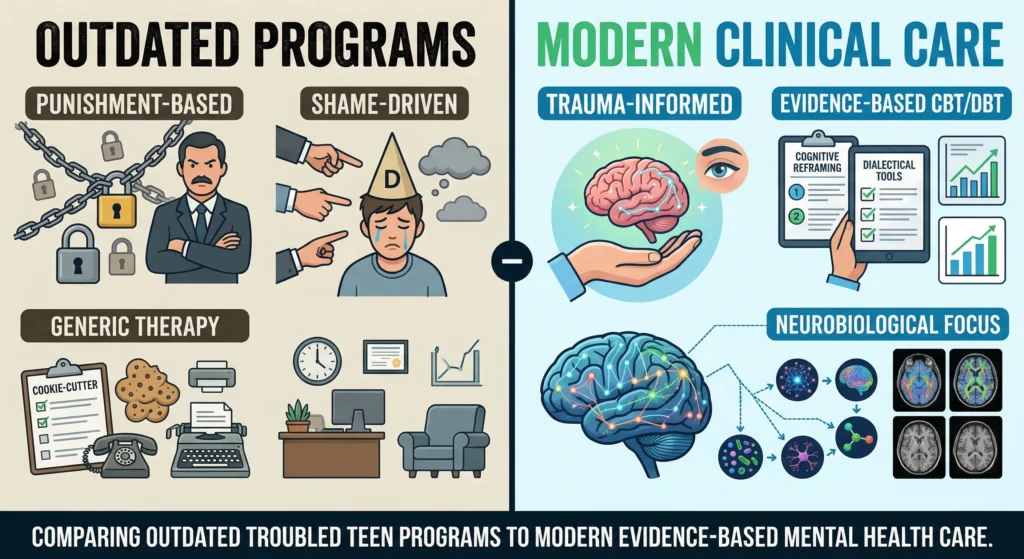
Infographic: left side—Outdated Programs (punishment-based, shame-driven, generic therapy); right side—Modern Clinical Care (trauma-informed, evidence-based CBT/DBT, neurobiological focus).
Image description: A side-by-side comparison of outdated troubled-teen approaches and modern evidence-based mental health care.
Section 3: The danger of "one size fits all" (levels of care)
If a facility tells you your child needs a 90-day residential stay before a clinical assessment, hang up the phone.
Not every crisis requires the same level of intervention. A responsible program offers a continuum of care—a stepped system of treatment intensity that matches your child’s clinical needs.
1. Residential treatment (highest intensity)
- What it is: 24/7 live-in medical and psychiatric supervision.
- Who it’s for: Teens who pose an immediate danger to themselves (suicidal planning, severe self-harm), those needing medically supervised detox for severe substance use, or teens who cannot stabilize in their current home environment.
2. Partial hospitalization program (PHP)
- What it is: Day treatment—clinical programming for about six hours a day, five days a week, with the teen sleeping at home.
- Who it’s for: Teens experiencing severe daytime panic, school refusal, or major depressive episodes that make functioning in a large high school impossible, but who don’t require overnight monitoring.
3. Intensive outpatient program (IOP)
- What it is: Three-hour therapy blocks, three to four days a week, typically after school.
- Who it’s for: Teens who are struggling but can still live at home and keep up with academics. IOPs provide a strong clinical safety net to prevent deeper crises.
A trustworthy facility places your teen in the least restrictive environment that remains medically safe and supports a step-down path as they recover.
Section 4: Age and developmental segregation
This is a crucial safety and clinical standard that separates excellent programs from mediocre ones.
A 12-year-old and a 17-year-old should not be in the same therapy group.
Although both are “teens,” a middle-schooler and a high-school senior are in very different developmental worlds.
- The 12-year-old: Faces early puberty, middle-school transitions, early social-media pressures, and separation anxiety.
- The 17-year-old: Navigates college decisions, complex relationships, independence, and exposure to higher-level substance use.
Grouping them together risks secondary trauma for the younger teen and prevents the older teen from sharing mature concerns. At Teen Mental Health Facility, treatment tracks are strictly divided by age and developmental stage to protect emotional safety and encourage honest peer support.
Photo description: Age-specific group therapy with similarly aged teens meeting in a circle with a therapist.

Section 5: Dual-diagnosis capabilities
In 2026, it’s increasingly common for teens with anxiety or depression to also be experimenting with substances.
Teens don’t use high-potency THC vapes, nicotine, alcohol, or pills just to “party.” They often self-medicate—to quiet racing thoughts, to numb pain, or to force focus.
As the National Institute on Drug Abuse (NIDA) explains, these are co-occurring disorders (dual diagnosis).
Red flag: If a program treats only “mental health” and discharges a teen for a positive THC test, or if it treats only “addiction” and ignores trauma, the treatment is likely to fail.
Choose a facility licensed and clinically equipped to treat both substance use and mental health conditions at the same time. You can’t heal a mind that’s flooded with substances, and you can’t stop the substances without addressing the underlying pain.
Section 6: Family integration (healing the ecosystem)
Here’s a hard truth: You can’t send a sick teen away to be “fixed,” then return them to an unchanged home and expect lasting recovery.
When a teen is in crisis, the whole family system is affected. Parents grow hypervigilant and exhausted. Siblings feel overlooked. The home can become tense and fraught.
If a program isolates the teen from parents, restricts contact, or blames the family outright, that’s a major red flag.
High-quality programs make family therapy central to care.
- Parent coaching: We teach parents how to move from trying to “fix” behavior to validating their teen’s experience.
- Boundary setting: We help families create firm, compassionate limits around behavior and substance use.
- Communication skills: We rebuild trust and restore healthy family interaction.
At Teen Mental Health Facility, parents are essential clinical partners. Healing happens together.
Section 7: Comprehensive academic support
Parents rightly worry that removing a teen from school for PHP or residential care will derail their academics.
“If they miss a month, they’ll fail the year—falling behind will make their anxiety worse.”
Mediocre programs say, “Don’t worry about school—focus on health.” While health is the priority, ignoring academics outright is a clinical mistake: academic stress is a major trigger for many teens.
The elite standard: Clinical care should integrate academics into the treatment day.
- Programs provide dedicated academic hours led by education specialists.
- We coordinate with your child’s school to collect assignments, extend deadlines, and help create a 504 plan or IEP so your teen returns legally protected and caught up.
We prevent academic decline while teaching teens how to manage school stress as part of their recovery.
Photo description: A teen working with a tutor in a bright facility room, integrating academic support with mental health care.

Section 8: The parent's checklist for vetting a facility
When you’re on the phone with an admissions coordinator, remember: you are interviewing them as much as they are assessing your child.
Use these non-negotiable questions to judge whether a program meets high clinical standards:
- “Are you Joint Commission (JCAHO) or CARF accredited?” (These accreditations reflect the highest national standards for healthcare and clinical safety.)
- “What specific evidence-based therapies do your clinicians use?” (Listen for CBT, DBT, and EMDR. Be cautious if they only say “counseling” or “milieu therapy”.)
- “Do you have a Board-Certified Child and Adolescent Psychiatrist on staff?” (A general practitioner isn’t always equipped to manage complex teenage brain chemistry.)
- “How often will my child see their individual therapist?” (In an intensive program, expect at least 1–2 individual sessions per week plus daily group work.)
- “What is your discharge planning process?” (A strong program begins discharge planning on Day 1—transitioning to step-down care and securing a local outpatient therapist for ongoing support.)
Conclusion: You are the ultimate advocate
The adolescent mental health system can feel like a maze, but you don’t have to navigate it alone or blindly.
Your child isn’t a “troubled teen” who needs punishment; they’re a developing person in a neurobiological crisis who needs medical and psychological care. By insisting on evidence-based therapy, family involvement, age-appropriate safety, and integrated academic support, you increase the chances that their first experience with treatment is healing rather than harmful.
You are your child’s most important advocate. The fact that you’re researching options, reading guides, and fighting for their future shows they have the greatest resource of all: a parent who won’t give up.
If you’re ready to find a program that meets rigorous clinical standards, contact the compassionate admissions team at Teen Mental Health Facility today for a free, confidential assessment.
Frequently Asked Questions (FAQs)
How long does a typical teen treatment program last? High-quality care is individualized, so there’s no fixed timeline. Commonly, an IOP or PHP runs 6–12 weeks. The goal is that teens master practical coping skills before stepping down to a lower level of care.
What if my teen refuses to go? Many teens resist at first—about 80% of our admissions initially refuse. Anxiety and depression often tell teens that avoiding treatment is safer. As a parent, you have the legal right and responsibility to consent to medical care for a minor. Our clinical team will coach you on having a firm, loving, and safe “non-negotiable” conversation to get them through the door.
Are these programs covered by commercial insurance? Yes. Clinical levels of care like PHP and IOP are medical services and are typically covered under the federal Mental Health Parity Act. Most major PPO plans cover a substantial portion of costs. We offer free benefits verification.
Will my child be overmedicated? Our approach is “skills before pills.” We avoid medication as a quick fix or chemical restraint. If a teen has severe biological depression, a child and adolescent psychiatrist may recommend a carefully monitored medication to establish a biological baseline—helping the teen engage in therapy. Medication decisions are always collaborative with parents.