


Teen Mental Health Treatment Programs in California: A Guide
Medical Disclaimer: The content provided in this article is for informational purposes only and does not constitute medical or legal advice. If your teen is experiencing an acute mental health crisis, active suicidal ideation, or engaging in severe self-harm, please call 988 or go to the nearest emergency room immediately. For confidential guidance on choosing the right level of clinical care for your child in California, contact Teen Mental Health Facility.
Introduction: The Golden State Pressure Cooker
California is known globally as the Golden State—a place of endless sunshine, innovation, and opportunity. From the tech-driven corridors of Silicon Valley to the entertainment hubs of Los Angeles and the affluent suburbs of Orange County, it is a state that celebrates high achievement and relentless forward momentum.
But for the teenagers growing up here, that “forward momentum” often feels like a treadmill they cannot step off.
Beneath the postcard-perfect exterior, California teens are facing an unprecedented mental health crisis. The pressure to get into elite UCs or out-of-state colleges, the intense scrutiny of influencer-driven social media, and the lingering economic and social anxieties of the 2020s have created a pressure cooker.
When your teenager begins to crack under this pressure—when the straight-A student refuses to get out of bed, or the star athlete starts self-harming, or your child completely isolates themselves in the digital world—your first instinct as a parent is to find help.
But searching for “teen mental health treatment in California” yields a dizzying, overwhelming sea of results. You will see luxury wellness retreats in Malibu, wilderness camps in the Sierras, locked psychiatric wards, and local outpatient clinics. How do you know what your child actually needs? How do you know what you can afford?
At Teen Mental Health Facility, we believe that transparency is the ultimate antidote to a parent’s fear. In this comprehensive 2026 guide, we will pull back the curtain on the California adolescent mental health industry. We will break down the exact types of treatment programs available, the real costs and insurance realities (including Medi-Cal), and how to vet any facility in the state to ensure your child receives elite, evidence-based care.
If you are ready to cut through the noise and find a program that relies on science and compassion, explore our Teen Treatment Programs at Teen Mental Health Facility.

Section 1: Decoding the Levels of Care in California
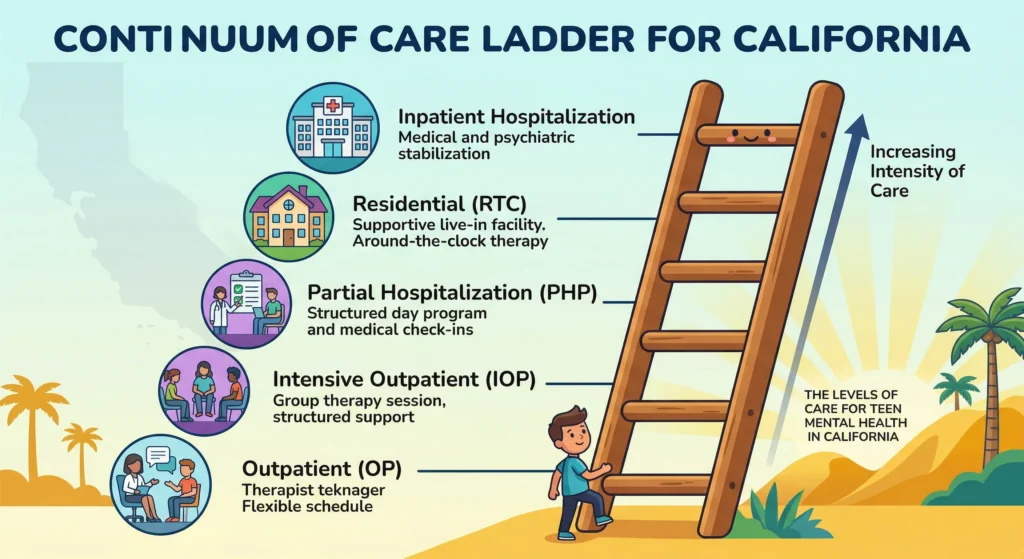
The biggest mistake parents make is assuming that “rehab” is a one-size-fits-all solution. In California, mental health treatment exists on a clinical continuum. You must match your teen’s specific medical severity to the correct “level of care.”
Here is the hierarchy of treatment programs, from highest intensity to lowest:
1. Inpatient Psychiatric Hospitalization (Crisis Stabilization)
- What it is: A locked, highly secure hospital ward. Stays are typically very short (3 to 10 days).
- Who it’s for: Teens who are in immediate, imminent danger of taking their own life, experiencing active psychosis (hallucinations/delusions), or surviving a suicide attempt.
- The Goal: Medical stabilization and keeping the child physically alive. It is not designed for long-term therapy or root-cause healing.
2. Residential Treatment Centers (RTC)
- What it is: 24/7 live-in care in a home-like but secure facility. Stays usually range from 30 to 90 days.
- Who it’s for: Teens who are medically stable but cannot break the cycle of severe depression, chronic self-harm, or substance abuse in their current home environment. It completely removes them from their triggers (school, toxic peers, social media).
- California Context: California has strict licensing laws for RTCs. Ensure the facility is licensed by the California Department of Social Services (DHCS) and accredited by JCAHO or CARF.
3. Partial Hospitalization Program (PHP)
- What it is: Often called “Day Treatment.” The teen attends clinical programming for 6 hours a day, 5 days a week, but sleeps safely at home (or in a supportive teen housing environment).
- Who it’s for: Teens who are experiencing school refusal, daily panic attacks, or major depressive episodes that make functioning in a 3,000-student high school impossible, but who do not require overnight clinical monitoring.
4. Intensive Outpatient Program (IOP)
- What it is: 3 hours of therapy a day, 3 to 4 days a week, usually after school.
- Who it’s for: Teens who are struggling with moderate anxiety or depression but are still able to maintain their academics and live at home. It acts as a powerful clinical safety net to prevent them from sliding into a deeper crisis.
Learn more about how these levels flow together by exploring our Intensive Outpatient and PHP Options.
Section 2: What Does Quality Treatment Actually Cost?
The fear of financial ruin keeps thousands of California families from seeking the help their teens desperately need. The stigma says that quality rehab is only for Hollywood celebrities or Silicon Valley executives. The law says otherwise.
The Mental Health Parity Act
Federal law (The Mental Health Parity and Addiction Equity Act) dictates that health insurance companies must cover mental health treatment at the exact same level they cover physical illnesses. If your teen needs a 30-day PHP program for severe depression, your insurance must treat it the same as a 30-day treatment for a physical illness, provided it is deemed “medically necessary.”
Private PPO and HMO Insurance in California
If you have private insurance through a California employer (such as Anthem Blue Cross, Kaiser Permanente, UnitedHealthcare, Aetna, or Cigna), your policy will typically cover a significant portion of residential, PHP, and IOP care.
- Out-of-Pocket Maximums: Because intensive mental health treatment is a front-loaded medical expense, families frequently hit their annual out-of-pocket maximum quickly. Once met, insurance often covers 100% of the remaining medically necessary care for the year.
- PPO vs. HMO: PPO plans offer “out-of-network” benefits, allowing you to choose premier, specialized facilities (like Teen Mental Health Facility) even if they are outside your direct network. HMOs (like Kaiser) require you to stay within their specific hospital networks unless you can secure a “Single Case Agreement.”
Medi-Cal (California's Medicaid Program)
For lower-income families, California offers robust mental health coverage through Medi-Cal. Medi-Cal covers outpatient therapy, psychiatric medication management, and, in severe cases, intensive day treatment or residential care.
- Note: Private, boutique facilities often do not accept Medi-Cal. However, every county in California has a designated mental health department (e.g., Los Angeles County Department of Mental Health) that provides referrals to state-funded, high-quality community clinics that accept this coverage.
At Teen Mental Health Facility, we have a dedicated Utilization Review team that fights the insurance battles for you. Let us run your benefits for free by visiting our Admissions and Insurance Verification page.
Section 3: California Minor Consent Laws (What Parents Must Know)
California has some of the most progressive mental health laws in the country regarding adolescents.
Under California law (Health and Safety Code Section 124260 and the recently updated AB 665), a minor who is 12 years of age or older may consent to outpatient mental health treatment or counseling services if a professional deems them mature enough to participate intelligently.
What this means for parents:
- In an outpatient setting, your teen has a high degree of medical privacy. A therapist cannot share the specifics of your teen’s sessions with you without the teen’s consent, unless the teen is an imminent danger to themselves or others.
- While this can feel frustrating for parents who want to know everything, this legal protection is actually a clinical asset. It allows the teenager to feel completely safe opening up to the therapist without fear of being “tattled on” or grounded at home.
- For higher levels of care (Residential or PHP), parental consent is still required, but fostering a collaborative environment where the teen wants to participate is crucial for long-term success.

Section 4: Evaluating Options Across the State
While we pride ourselves on the elite, evidence-based care provided at Teen Mental Health Facility in Southern California, we know that geography, insurance constraints, and specific clinical needs mean we might not be the exact right fit for every single family in the state.
Whether you are looking for a program in the Bay Area, the Central Valley, or San Diego, you must be a ruthless advocate for your child. The “Troubled Teen Industry” still exists, and you must vet any facility carefully.
The Parent's Checklist for Vetting ANY California Facility:
- “Are you Joint Commission (JCAHO) or CARF accredited?” These are the highest national standards for healthcare and clinical safety. If a California facility does not have this accreditation, do not send your child there.
- “Do you use Evidence-Based Practices (EBPs)?” Ask them to specifically name their therapeutic modalities. You want to hear CBT (Cognitive Behavioral Therapy), DBT (Dialectical Behavior Therapy), and EMDR (for trauma). Beware of programs that only offer “milieu therapy” or “behavior modification.”
- “Do you have a Board-Certified Child and Adolescent Psychiatrist on staff?” A general practitioner or a standard adult psychiatrist is not equipped to manage complex, developing teenage brain chemistry.
- “Are your groups segregated by age?” A 12-year-old middle schooler and an 18-year-old high school senior should never be in the same process group. The developmental trauma and conversations are vastly different, and mixing them is a major clinical red flag.
- “How do you handle academics?” In California, falling behind in high school is a primary driver of teen anxiety. A top-tier PHP or Residential program will have dedicated educational liaisons who coordinate with your child’s home school district to maintain their transcript and secure 504 plans or IEPs.
For a database of state-approved resources, you can also consult the California Department of Health Care Services (DHCS) or NAMI California.
Section 5: The "Dual Diagnosis" Reality
In 2026, it is incredibly rare to see a California teenager struggling with severe anxiety or depression who is not also experimenting with a substance.
Teens do not use high-potency THC vapes (which are ubiquitous in California), nicotine, or prescription pills simply to “party.” They use them to self-medicate. They vape nicotine for the stimulant effect to force their depressed brain to focus; they use marijuana concentrates (wax/dabs) to shut off the agonizing, racing thoughts of generalized anxiety at night.
According to the Substance Abuse and Mental Health Services Administration (SAMHSA), these are called Co-Occurring Disorders (or Dual Diagnosis).
If you send your child to a program that only treats “mental health” and kicks them out for testing positive for THC, or a program that only treats “addiction” and ignores the underlying trauma, the treatment will fail. You must choose a facility that is licensed and clinically equipped to treat the addiction and the mental health condition at the exact same time.
Section 6: Why Choose Teen Mental Health Facility?
If you are located in Southern California—or are willing to travel to access premier care—Teen Mental Health Facility stands apart from the crowded landscape.
We do not believe in punishing behavior; we believe in healing the brain.
- Clinical Excellence: We employ doctorate-level clinicians and board-certified adolescent psychiatrists who specialize exclusively in the modern teenage experience.
- Family Integration: We know that when a teen is sick, the whole family system is sick. We mandate family therapy, parent coaching, and boundary-setting workshops so that your teen returns to a healed ecosystem.
- Holistic California Healing: We take advantage of our beautiful environment. We integrate somatic therapies, outdoor experiential therapy, and mindfulness to get teens out of their digital screens and back into their physical bodies.
- Academic Protection: We view your teen’s academic future as a critical component of their mental health. We work directly with their school counselors to ensure they don’t fall off the academic map while they are saving their own life.

Conclusion: Do Not Wait for the Crash
The hardest part of being a parent is realizing you cannot fix your child’s pain with just your love. Love is the foundation, but love alone cannot cure a neurobiological disorder.
Waiting for your teen to “grow out of it” is a gamble with their life.
Intervening early is not an overreaction; it is the ultimate act of parental strength. It shows your teenager that you see their pain, you validate it, and you will move mountains to get them the help they deserve.
Your vibrant, capable, joyful child is still in there. They are just buried under a heavy blanket of depression, anxiety, or trauma. Let us help you lift it off.
If you are ready to explore your options and find the exact right fit for your family, contact our compassionate admissions team at Teen Mental Health Facility today for a free, confidential clinical assessment.
Frequently Asked Questions (FAQs)
Will my teen fall behind in school if they go to a PHP or IOP? No. Our PHP program includes dedicated, supervised academic hours to ensure students stay caught up with their coursework. We act as a liaison with their California high school to manage their workload. Our IOP program takes place after school hours, specifically designed not to interfere with their standard academic day.
What if my teen flat-out refuses to go to treatment? This is incredibly common. Depression tells them that treatment won’t work and that avoiding it is safer. As a parent of a minor, you have the legal right and responsibility to consent to medical treatment for your child. Our clinical team can coach you on how to have a firm, loving, “non-negotiable” conversation to get them through the door.
Are group therapy sessions safe? Won’t they just learn bad behaviors from other teens? This is a common fear, but the reality is the opposite. Our groups are heavily moderated by licensed clinicians who maintain strict behavioral boundaries. Isolation is the greatest danger of depression. When a teen sits in a room with other high-functioning, “normal” kids who are fighting the exact same invisible battle, the shame evaporates. Peer validation is often the turning point in recovery.
Can I tour the facility before admitting my child? Absolutely. Transparency is a core value of a reputable program. We encourage parents to speak with our clinical directors, tour the environments (in-person or virtually), and ask as many questions as necessary to feel completely comfortable with the care their child will receive.