

Medical Disclaimer: The content provided in this article is for informational purposes only and does not constitute medical advice. If your teen’s digital habits have led to severe isolation, cyberbullying trauma, active suicidal ideation, or self-harm, please call 988 or go to the nearest emergency room immediately. For a confidential clinical assessment and guidance on admissions, contact Teen Mental Health Facility.
Introduction: The Silent Crisis in Their Pocket
As a parent, you remember a time when your child’s world was relatively small and manageable. Their biggest stressors were making the soccer team, a tough math test, or a minor disagreement at the lunch table. When the school bell rang at 3:00 PM, the pressure turned off. They came home to a safe sanctuary.
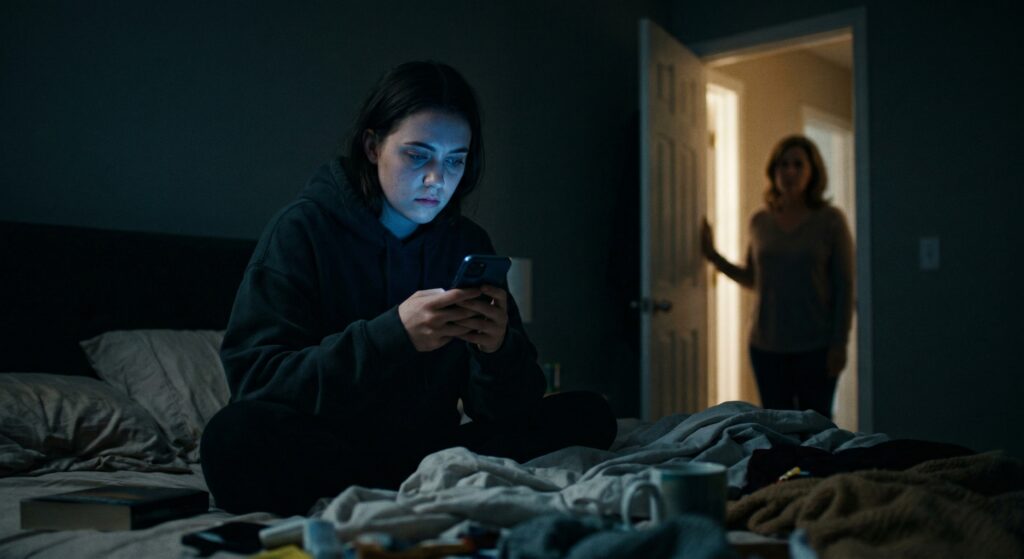
Today, for modern teenagers, the school bell never truly rings. The pressure never turns off. The bullies, the social hierarchy, and the impossible beauty standards follow them home, into the car, and right into their beds at 2:00 AM.
The sanctuary has been breached by the smartphone.
If you are raising a teenager in 2026, you are likely exhausted from the daily battle over screen time. You see the glow under their bedroom door late at night. You see the immediate, explosive irritability when you ask them to put the phone away at dinner. You watch as a child who used to be vibrant and engaged slowly retreats into a digital shell, speaking mostly in one-word answers.
You find yourself asking a terrifying question: “Is it just normal teenage moodiness, or is this phone destroying my child’s mental health?”
At Teen Mental Health Facility, we hear this from heartbroken parents every single day. We are currently treating the first generation of adolescents who have never known a world without algorithmic social media—and their developing brains are paying a devastating price.
In this comprehensive guide, we will pull back the curtain on the digital landscape. We will explain the neuroscience of why your teen cannot “just log off,” how social media acts as an accelerant for clinical anxiety and depression, and how to know when a bad habit has morphed into a clinical crisis requiring professional intervention.
If you believe your teen is drowning in the digital world and needs a lifeline, explore our Teen Treatment Programs at Teen Mental Health Facility.
Section 1: The Neuroscience of the Scroll (Why They Can’t Stop)
The first step to helping your teenager is realizing that you are not fighting their willpower; you are fighting a multi-billion-dollar industry engineered by neuroscientists to hijack your child’s attention.
When parents tell their teens to “just put the phone down,” they misunderstand the biological grip of the device. Apps like TikTok, Instagram, and Snapchat are built on a psychological principle called the Variable Reward Schedule—the exact same mechanism used in casino slot machines.
The Dopamine Hijack
When your teen pulls down to refresh their feed, they don’t know what they are going to get. Will it be a boring advertisement? A text from a crush? A video that makes them laugh out loud? A notification that someone “liked” their photo?
This unpredictability causes the brain to dump massive amounts of Dopamine (the neurotransmitter responsible for reward and motivation) in anticipation of what might come next. Over time, the teen’s brain becomes reliant on these rapid, cheap hits of digital dopamine just to feel a baseline level of “okay.”
The Vulnerable Teenage Brain
According to the American Psychological Association (APA), the adolescent brain is uniquely vulnerable to this hijack.
- The Amygdala: The emotional, impulse-driven center of the brain is fully active in teenagers. It craves peer validation and social inclusion above all else.
- The Prefrontal Cortex: The logical, “brake pedal” of the brain—responsible for impulse control and long-term planning—does not finish developing until age 25.
Your teenager literally lacks the biological hardware to self-regulate their social media usage. Asking them to simply “log off” when their entire social survival feels tied to the app is a biological impossibility without strict, external parental boundaries.
Section 2: How Social Media Fuels Clinical Mental Illness
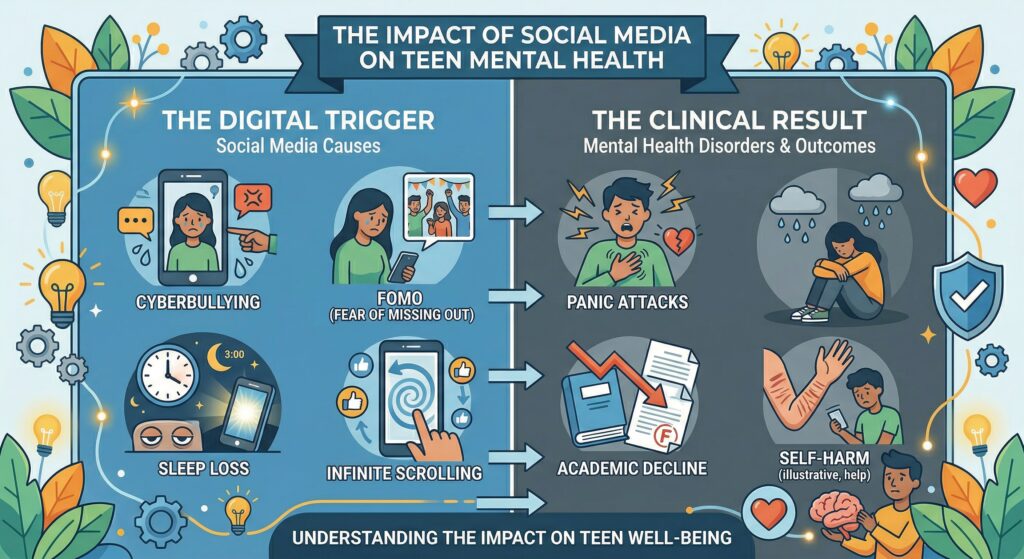
Social media is not the sole cause of mental illness, but it acts as a massive accelerant for underlying vulnerabilities. Here is how the digital world directly translates into clinical diagnoses we treat at our facility.
1. Social Anxiety and Hyper-Surveillance
In the past, making a mistake was embarrassing, but it was fleeting. Today, teenage life is lived on a permanent stage.
- The Highlight Reel: Teens are constantly comparing their messy, behind-the-scenes reality to the heavily curated, filtered “highlight reels” of thousands of peers and influencers.
- The Surveillance State: With location tracking (like Snap Map) and read receipts, teens constantly know where their friends are and who is hanging out without them. This triggers profound FOMO (Fear Of Missing Out), keeping the nervous system in a chronic state of “Fight or Flight” panic.
2. Major Depressive Disorder and the “Algorithm of Sadness”
Algorithms are designed to maximize engagement. If a teenager lingers on a sad video for three seconds longer than a funny video, the algorithm learns what holds their attention.
- The Echo Chamber: If a teen is feeling slightly down and watches a video about depression, the app will instantly flood their “For You” page with hundreds of videos about hopelessness, self-harm, or eating disorders. The algorithm validates and amplifies their sadness, trapping them in an echo chamber that convinces them that life is entirely bleak and meaningless.
3. Sleep Architecture Disruption
The most immediate, devastating impact of social media is on sleep.
- The Blue Light Effect: Staring at a screen suppresses melatonin production, tricking the brain into thinking it is daytime.
- The Psychological Arousal: Reading a distressing comment at 11:00 PM spikes cortisol. When a teen is sleep-deprived, their emotional regulation collapses, turning normal daily stressors into catastrophic meltdowns the next morning.
Section 3: Red Flags — When Is It a Crisis?
Because practically every teenager in America is attached to their phone, it can be incredibly difficult to tell the difference between normal teenage tech habits and a mental health crisis.
You need to look for Functional Impairment. Is the phone stopping them from living their actual life? Look for these hidden red flags:
1. The “Zombie” State and Withdrawal Rage
- The Sign: When they are on their phone, their eyes are glazed over. They do not hear you when you speak to them.
- The Crisis: If you ask them to hand over the phone, they do not just get annoyed—they erupt into a terrifying, explosive rage, or they suffer a full-blown panic attack. This is a sign of severe chemical withdrawal and psychological dependency.
2. Radical Changes in Appearance and Eating Habits
- The Sign: A sudden obsession with their appearance, constantly taking body-checking selfies, or developing extreme anxieties around food and exercise.
- The Crisis: Social media’s “filter dysmorphia” drives staggering rates of anorexia and bulimia. If their self-worth is entirely tethered to how they look online, they are at high risk for an eating disorder.
3. The “Finsta” and Digital Self-Harm
- The Sign: They have multiple hidden accounts (a “Fake Instagram” or alt-TikTok).
- The Crisis: Teens often use hidden accounts to post dark, depressive thoughts they wouldn’t share publicly. Even more alarming is the rise of Digital Self-Harm, where teens anonymously send abusive, bullying messages to themselves to validate their own toxic inner critic.
Section 4: Cyberbullying — The inescapable Trauma
Bullying used to end when the school day ended. Today, cyberbullying is a 24/7 psychological assault.
According to the Cyberbullying Research Center, adolescent victims of cyberbullying are significantly more likely to engage in self-harm and suicidal ideation.
- It is Permanent: A humiliating photo or cruel rumor can be screenshotted, shared, and immortalized online forever.
- It is Public: The humiliation happens in front of an audience of hundreds or thousands, rather than just a few kids in a hallway.
- It is Invasive: The bullying invades the one place they are supposed to be safe: their bedroom.
Parent Action Step: If your child is the victim of cyberbullying, do not simply tell them to “ignore it” or “delete the app.” To a teenager, deleting the app feels like social suicide. You must validate the profound trauma of the experience. Screenshot the evidence, involve the school administration immediately, and seek trauma-informed counseling for your teen.

Section 5: How to Intervene (Without Starting a War)
If you rip the phone out of your teenager’s hand and declare a permanent ban on social media, you will likely trigger massive rebellion and secrecy. You have to intervene strategically and collaboratively.
1. The “Tech-Free Bedroom” Rule
This is the single most important boundary a parent can set.
- The Rule: No smartphones, tablets, or laptops in the bedroom after 9:00 PM.
- The Execution: Buy an old-school alarm clock for their room. Create a “charging station” in the kitchen where everyone in the family (including parents) plugs their phones in for the night. Framing it as a family-wide health initiative removes the feeling of punishment.
2. Use the “I Notice” Script
Do not attack their character or their friends. Attack the physical symptoms you are observing.
- Instead of: “You are addicted to that stupid phone and it’s ruining your brain.”
- Try: “I’ve noticed that after you spend a few hours scrolling in your room, you seem really exhausted and irritable when you come out. I hate seeing you feel so drained. Have you noticed that, too?”
3. A Supervised “Digital Detox”
If the situation is severe, you may need to implement a 48-to-72-hour complete digital detox.
- Expect massive resistance and withdrawal symptoms for the first 12 hours. However, by day two or three, the brain’s dopamine receptors begin to reset. Parents almost universally report that their teen suddenly “wakes up,” makes eye contact, and starts engaging in offline hobbies (drawing, reading, talking) again.
Section 6: When Boundaries Aren’t Enough (Seeking Professional Treatment)
Sometimes, the damage caused by the digital world runs too deep for a household “screen time limit” to fix.
If your teen’s social media usage has triggered severe clinical depression, school refusal, self-harming behaviors, or an inability to function in the real world, it is time to step in with professional clinical intervention.
At Teen Mental Health Facility, we do not just take away the phone; we treat the underlying pain that made the phone their only source of safety.
How Our Levels of Care Help:
- Intensive Outpatient Program (IOP): If your teen is struggling but still able to attend school, our IOP (typically 3 hours a day, 3-4 days a week) provides a powerful clinical anchor. We teach Dialectical Behavior Therapy (DBT) skills, giving them the emotional tools to survive FOMO, cyberbullying, and peer pressure without having a panic attack. Learn more about our Intensive Outpatient Programs.
- Partial Hospitalization Program (PHP): If your teen is trapped in severe depression or cannot attend standard high school, PHP offers full-day immersive treatment. They step out of the digital matrix and into a safe, highly structured clinical environment. They learn how to interact face-to-face, process trauma with licensed therapists, and rebuild their self-worth offline.
- Residential Treatment: For teens in acute danger of self-harm or suicide, a residential stay completely removes the toxic digital environment, providing 24/7 medical and psychiatric stabilization to reset their nervous system entirely.

Conclusion: Reclaiming Their Adolescence
Social media companies view your teenager as a data point. They view their attention as a commodity to be harvested for profit, regardless of the psychological cost.
You are the only line of defense.
You have the power to say, “Enough.” You have the power to show them that their worth is not measured in “likes,” streaks, or followers. Their worth is inherent, unchangeable, and infinitely valuable.
If the digital world has stolen your child’s joy, you do not have to fight this battle alone. The damage is not permanent. With the right therapeutic tools, we can help your teen rebuild their real-world resilience, discover their authentic identity, and finally put the screen down.
If you are ready to help your child reconnect with their life, contact the compassionate admissions team at Teen Mental Health Facility today for a free, confidential assessment.
Frequently Asked Questions (FAQs)
At what age should I give my child a smartphone? While every family is different, major psychological organizations and initiatives (like “Wait Until 8th”) strongly recommend delaying smartphones until at least 8th grade (age 13-14), and delaying social media access until age 16. The longer you wait, the more time their prefrontal cortex has to develop the necessary impulse control to handle the algorithm.
If I take their phone away, won’t they be socially isolated? This is the ultimate paradox. The phone promises connection but delivers isolation. While taking the phone away may temporarily cause them to miss out on digital chatter, it forces them to engage in real social behaviors—calling a friend to hang out, joining a club, or speaking face-to-face. Real connection heals; digital connection drains.
Does insurance cover treatment if social media caused the depression? Yes. Insurance covers the clinical diagnosis (e.g., Major Depressive Disorder, Generalized Anxiety Disorder, PTSD), regardless of what triggered it. If social media and cyberbullying have resulted in a clinical impairment, your teen’s treatment in a PHP or IOP is typically covered by major PPO insurance plans under the Mental Health Parity Act. Our team can verify your benefits for free.
How do I know if they are just “addicted to their phone” or actually depressed? Look at their baseline functioning. If you remove the phone and they simply complain but eventually go read a book or play outside, it’s a bad habit. If you remove the phone and they experience severe panic attacks, express thoughts of wanting to die, or exhibit a total inability to feel joy in the real world (Anhedonia), it has crossed into clinical depression and requires professional help.