


ADHD vs. Anxiety in Teens: How to Tell the Difference (And Why It Matters)
Medical Disclaimer: The content provided in this article is for informational purposes only and does not constitute medical advice. Accurate diagnosis of neurodevelopmental and mood disorders requires a comprehensive evaluation by a licensed psychiatric professional. If your teen is experiencing severe panic attacks, school refusal, or suicidal ideation, please call 988 or go to the nearest emergency room immediately. For confidential assessment and admissions, contact Teen Mental Health Facility.
Introduction: The "Scattered" Teenager
You are looking at your teenager’s bedroom floor, which is currently covered in clothes, half-finished homework, and empty water bottles. You are looking at their report card, which shows missing assignments despite the fact that you saw them sitting at their desk for three hours last night.
You watch them bounce their leg endlessly during dinner. You see them snap irritably when you ask a simple question about their day. You notice they are withdrawing from family activities, retreating to the glow of their phone.
As a parent, you know something is wrong. You consult with teachers, school counselors, and Google, and you keep hitting the same two diagnoses: ADHD or Anxiety.
The problem is that on the surface, they look almost identical.
A teen who cannot focus in class might have ADHD (Attention-Deficit/Hyperactivity Disorder), meaning their brain lacks the dopamine to sustain attention. Or, they might have Generalized Anxiety Disorder, meaning they are so consumed by terrifying internal “what if” scenarios that they literally cannot hear the teacher speaking.
Treating the wrong condition can make things worse. Giving a highly anxious teen a stimulant medication can trigger severe panic attacks. Conversely, putting an ADHD teen into standard talk therapy without addressing their executive function deficits will leave them feeling like a “failure” who just can’t try hard enough.
At Teen Mental Health Facility, we specialize in untangling this complex knot. In this comprehensive guide, we will break down the neurobiological differences between ADHD and Anxiety, explore the crucial “Symptom Showdown” (how to decode the why behind the behavior), and provide a roadmap for getting your child the precise help they need.
If you are tired of guessing and ready for clarity, explore our Teen Diagnostic and Treatment Programs.

The Root Cause: Brain Chemistry vs. Threat Detection
To tell the difference between ADHD and Anxiety, we must look beneath the behavior to the biological engine driving it.
ADHD: The "Dopamine Deficit" (A Neurodevelopmental Disorder)
ADHD is not a mood disorder; it is a neurodevelopmental disorder. It means the brain’s frontal lobe—the “CEO” responsible for executive function, planning, and impulse control—develops differently.
According to CHADD (Children and Adults with Attention-Deficit/Hyperactivity Disorder), the ADHD brain struggles to produce and efficiently use Dopamine and Norepinephrine. These are the chemicals responsible for motivation and reward.
- The Result: The ADHD brain is chronically under-stimulated. It is constantly hunting for dopamine. This is why a teen with ADHD can play a highly stimulating video game for six hours straight (Hyperfocus) but physically cannot force themselves to read two pages of a boring history textbook (Inattention).
Anxiety: The "Overactive Alarm" (A Mood Disorder)
Anxiety, on the other hand, is driven by the Amygdala—the brain’s primitive threat-detection center. In a healthy brain, the amygdala sounds the alarm (releasing cortisol and adrenaline) when there is a physical threat, like a car swerving into your lane. In a brain with an Anxiety Disorder, the alarm is stuck in the “ON” position.
- The Result: The brain perceives non-lethal stressors (a math test, a text message left on “read,” a crowded cafeteria) as life-or-death threats. The teenager is locked in a constant state of “Fight, Flight, or Freeze.”
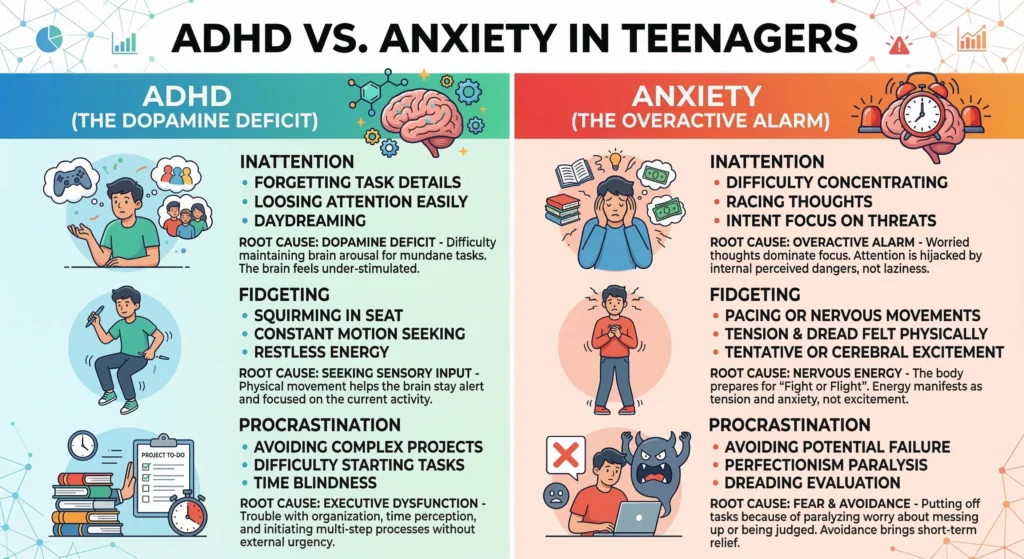
The Symptom Showdown: Decoding the "Why"
Because the outward behaviors of ADHD and Anxiety overlap so heavily, clinicians have to play detective. We don’t just ask what the teen is doing; we ask why they are doing it.
Here is how the same behavior is driven by two completely different engines.
1. Inattention and "Zoning Out"
The ADHD Teen: They are easily distracted by external stimuli. A bird flies by the window, someone taps a pencil, or a random thought pops into their head, and their focus is hijacked because their brain is desperately seeking something more interesting than the current task. The Anxious Teen: They are distracted by internal stimuli. They are staring at the whiteboard, but they aren’t seeing math equations. They are catastrophizing: “What if I fail this test? If I fail, I won’t get into college. My parents will be so disappointed.” The fear consumes their working memory, leaving no room for the lesson.
2. Restlessness and Fidgeting
The ADHD Teen: Their body is moving to keep their brain awake. Bouncing a leg, clicking a pen, or shifting in their seat provides a low-level physical stimulation that actually helps their under-aroused brain focus. The Anxious Teen: Their body is moving because it is flooded with adrenaline. They are in “Flight” mode but are forced to sit in a desk. The fidgeting is a release valve for nervous, panicky energy.
3. Procrastination and Missing Assignments
The ADHD Teen: They suffer from Task Paralysis (Executive Dysfunction). They might genuinely want to do the essay, but their brain cannot figure out how to break the project into manageable steps. They feel overwhelmed by the lack of structure and put it off until the adrenaline of the last minute forces them into action. The Anxious Teen: They suffer from Perfectionism. They are terrified that the essay won’t be good enough. The fear of receiving a bad grade is so paralyzing that avoiding the assignment entirely feels safer than trying and failing.
4. Social Struggles and Interrupting
The ADHD Teen: They struggle with impulse control. They might blurt out an answer, interrupt a friend’s story, or miss social cues because their brain moves too fast to filter their behavior. Afterward, they may feel confused as to why their friends are annoyed. The Anxious Teen: They struggle with Social Anxiety. They might overthink every word they said during lunch, replaying the conversation for days. They might interrupt or talk too fast because the silence makes them panic, or they may withdraw completely out of a fear of being judged.
The "Masking" Phenomenon: Why Girls Are Missed
For decades, the medical model of ADHD was based on the behavior of hyperactive 8-year-old boys. As a result, an entire generation of teenage girls has slipped through the cracks.
Girls are far more likely to present with Inattentive-Type ADHD rather than Hyperactive-Type. They aren’t throwing chairs; they are staring out the window. Furthermore, societal conditioning teaches girls to be “pleasers,” leading them to engage in Masking.
- What Masking Looks Like: A teenage girl with ADHD will use massive amounts of adrenaline and anxiety to force herself to sit still, smile, and turn in her homework.
- The Cost: By the time she gets home, she is completely depleted. She collapses into a sobbing, exhausted mess.
Because doctors see her good grades and polite demeanor, they diagnose her with Anxiety or Depression. They treat the result of the masking, but miss the ADHD that is causing it. At Teen Mental Health Facility, our diagnostic protocols are specifically designed to look past the mask.
The Vicious Cycle: When ADHD Causes Anxiety
Here is where the diagnosis gets incredibly complex: Comorbidity.
According to the Anxiety & Depression Association of America (ADAA), approximately 50% of adults and children with ADHD also have an anxiety disorder.
Very often, untreated ADHD is the direct cause of the anxiety.
Imagine living your entire life with a brain that drops important files, forgets social plans, and misses deadlines. You are constantly letting people down. You are constantly getting in trouble. Over time, you learn that you cannot trust your own brain.
To survive, you develop severe anxiety. You become hyper-vigilant, checking your backpack ten times before school because you are terrified of forgetting your homework again. Your anxiety becomes a coping mechanism for your executive dysfunction.
The Treatment Trap: If a doctor only prescribes an anti-anxiety medication (like an SSRI) without treating the ADHD, the teen might feel calmer, but they will still fail their classes because their executive function hasn’t improved. You have taken away their anxiety—which was the only tool they were using to get things done. We must treat the root.
The Digital Escalation: Screens and Symptoms
Parents often ask, “Did the smartphone cause this?”
Smartphones do not cause ADHD or Anxiety disorders, but they are the ultimate accelerant for both.
- For the ADHD Teen: Apps like TikTok are perfectly engineered dopamine delivery systems. The rapid-fire, 15-second videos provide a constant, effortless drip of reward. This makes returning to the “slow” real world (like reading a book) feel physically painful.
- For the Anxious Teen: Social media provides an endless feed of social comparison, cyberbullying, and “doomscrolling” (consuming negative global news). It feeds the amygdala a constant diet of threat.
As part of our treatment process, we help teens develop Digital Boundaries, teaching them how their devices are manipulating their specific brain chemistry.
!

How Parents Can Investigate at Home (The "Context" Clue)
If you are trying to parse out what your teen is dealing with while waiting for an evaluation, look at Context.
Anxiety is often situation-specific. ADHD is usually global.
- The Anxiety Test: Does your teen focus perfectly well when they are safe at home building a Lego set or reading a fantasy novel, but entirely lose their focus when studying for a heavily weighted AP test? The inability to focus is likely triggered by the context of the stress.
- The ADHD Test: Is the forgetfulness and distraction present everywhere? Do they forget their cleats on the way to their favorite sport? Do they lose their phone while hanging out with their best friends? If the executive dysfunction happens even during low-stress, enjoyable activities, it leans heavily toward ADHD.
The Danger of the Wrong Diagnosis
Getting this right is a matter of life and death for a teenager’s self-esteem.
- Misdiagnosing ADHD as Anxiety: The teen is put in standard talk therapy to discuss their “worries.” But talking doesn’t fix a dopamine deficit. The teen feels broken because the therapy isn’t working.
- Misdiagnosing Anxiety as ADHD: The teen is prescribed a stimulant (like Adderall or Ritalin). Stimulants increase heart rate and central nervous system activity. For a teen whose nervous system is already in “Fight or Flight,” a stimulant can induce terrifying, full-blown panic attacks.
This is why you cannot rely on a 15-minute pediatrician visit for a mental health diagnosis. It requires a comprehensive, multi-disciplinary psychiatric evaluation.
Treatment at Teen Mental Health Facility: Rewiring the Brain
At Teen Mental Health Facility, we do not guess. We use evidence-based assessments to uncover the exact neurological profile of your child, and we build a customized treatment plan based on that data.
1. Comprehensive Psychiatric Evaluation
We look at the whole picture—family history, trauma, academic performance, and biological markers—to distinguish between overlapping conditions and identify comorbidities.
2. Cognitive Behavioral Therapy (CBT) and DBT
For both Anxiety and ADHD, behavioral therapy is essential.
- We use CBT to challenge the “Imposter Syndrome” and catastrophic thinking of anxiety.
- We use Dialectical Behavior Therapy (DBT) to teach emotional regulation—helping the impulsive ADHD teen pause between a feeling and an action.
3. Executive Function Coaching
For our ADHD clients, therapy goes beyond talking about feelings. We provide practical “Life Scaffolding.” We teach them how to use visual timers, chunk assignments into micro-tasks, and build routines that rely on external systems rather than flawed working memory.
4. Levels of Care to Match the Need
If your teen is trapped in a cycle of school refusal or severe depression resulting from these untreated conditions, weekly therapy is often not enough.
- Intensive Outpatient Program (IOP): 3 hours a day, 3-4 days a week after school. Ideal for building skills while staying in their academic routine.
- Partial Hospitalization Program (PHP): A full-day program that replaces school temporarily to provide robust psychiatric stabilization and intensive therapy. Learn more about our Intensive Treatment Options.
!

Conclusion: Stop the Guesswork, Start the Healing
Watching your teenager struggle is exhausting, but you do not have to figure this out on your own.
Whether your child is battling the exhausting, chaotic engine of ADHD or the terrifying, suffocating alarm bell of Anxiety—or both—they are not broken. They simply have a brain that requires a different operating manual.
When a teen finally gets the correct diagnosis, the relief is profound. It is the moment they realize they aren’t “stupid” or “lazy”; they have a treatable medical condition.
Give your child the gift of clarity. Give them the tools to understand their own mind.
If you are ready to find the right path forward for your family, contact our admissions team at Teen Mental Health Facility today for a confidential consultation.
Frequently Asked Questions (FAQs)
Can my teen have both ADHD and Anxiety? Yes. In fact, it is incredibly common. According to the National Institute of Mental Health (NIMH), many adolescents present with comorbid conditions. Treating them requires a delicate, coordinated approach, often utilizing a combination of specific medications and behavioral therapies to ensure treating one doesn’t exacerbate the other.
Will my teen have to take medication for ADHD? Medication is a highly effective tool for ADHD, but it is never mandatory. We believe in a “Skills before Pills” approach whenever possible. If medication is recommended by our psychiatric team to provide a biological baseline, it will always be thoroughly discussed with you and your teen.
How do I bring this up with my teenager without making them defensive? Avoid labels initially. Instead of saying, “I think you have ADHD,” focus on their experience. Try: “I notice you seem really exhausted after studying, and it looks like it’s taking a massive toll on you. I want to help make things easier. Would you be open to talking to an expert who helps kids figure out how their specific brain learns best?”
What if their grades are fine? Do they still need an evaluation? Absolutely. Many highly intelligent teens use extreme anxiety to compensate for ADHD, resulting in good grades but a destroyed mental state. If their academic success is costing them their sleep, their joy, and their peace of mind, they need an evaluation.