How CBT and DBT Help Teens Manage Anxiety and Emotions
Medical Disclaimer: The content provided in this article is for informational purposes only and does not constitute medical advice. If your teen is experiencing a severe mental health crisis, active suicidal ideation, or is engaging in life-threatening self-harm, please call 988 or go to the nearest emergency room immediately. For a confidential clinical assessment and admission inquiries, contact Teen Mental Health Facility.
Introduction: Why "Just Breathe" Doesn't Work
If you have ever tried to calm down a teenager in the middle of a panic attack or an emotional meltdown, you already know the truth: telling them to “just relax” or “take a deep breath” is about as effective as throwing a cup of water on a house fire.
In fact, it often makes the explosion worse.
When a teenager’s brain is hijacked by severe anxiety or crushing depression, they are not behaving logically. They are trapped in a biological survival state. They don’t just feel sad or nervous; they feel like their world is physically collapsing. Traditional advice fails because it assumes the teen has the internal tools to regulate their own nervous system.
The reality is, most teens with mental health struggles are entirely missing that toolkit.
At Teen Mental Health Facility, we hear the frustration from parents every single day: “We talk and talk, but nothing changes.” That is because traditional “talk therapy”—where a teen just vents about their week for 50 minutes—is often not enough to break the cycle of a severe mood disorder. To actually change behavior, you need structured, evidence-based, skill-building therapies.
Enter the gold standards of modern adolescent psychology: Cognitive Behavioral Therapy (CBT) and Dialectical Behavior Therapy (DBT).
In this comprehensive guide, we will demystify the “alphabet soup” of clinical therapy. We will explain the neuroscience of the teenage brain, break down exactly how CBT and DBT work, and show you how these powerful modalities can give your teen the tools they need to finally navigate the storm.
If you are ready to move beyond venting and start building skills, explore our Teen Treatment Programs at Teen Mental Health Facility.
!
Section 1: The Teenage Brain on Overdrive
Before we can understand how the therapies work, we must understand the machinery they are repairing.
The adolescent brain is a construction zone. According to the American Psychological Association (APA), the teenage brain undergoes a massive pruning and rewiring phase that makes it incredibly efficient but also highly volatile.
- The Amygdala (The Emotion Center): This part of the brain is fully developed in teenagers. It is responsible for processing fear, threat, and intense emotion. In adolescents, the amygdala is hyper-reactive. A perceived social rejection (like a friend not texting back) feels like a literal life-or-death threat to their nervous system.
- The Prefrontal Cortex (The Logic Center): This is the “CEO” of the brain, responsible for impulse control, rational thinking, and emotional regulation. It does not finish developing until age 25.
The Mismatch: Your teenager has a high-powered sports car engine (the Amygdala) with bicycle brakes (the Prefrontal Cortex). When they experience anxiety, the engine revs to 100 mph, and they simply do not have the biological hardware to stop the car.
CBT and DBT act as the external brake pads. They train the Prefrontal Cortex to come online and take the steering wheel back from the Amygdala.
Section 2: Cognitive Behavioral Therapy (CBT) Explained
Cognitive Behavioral Therapy (CBT) is the most widely researched and heavily utilized therapy for treating anxiety and depression. It is highly structured, goal-oriented, and focused entirely on the present moment.
The CBT Triangle
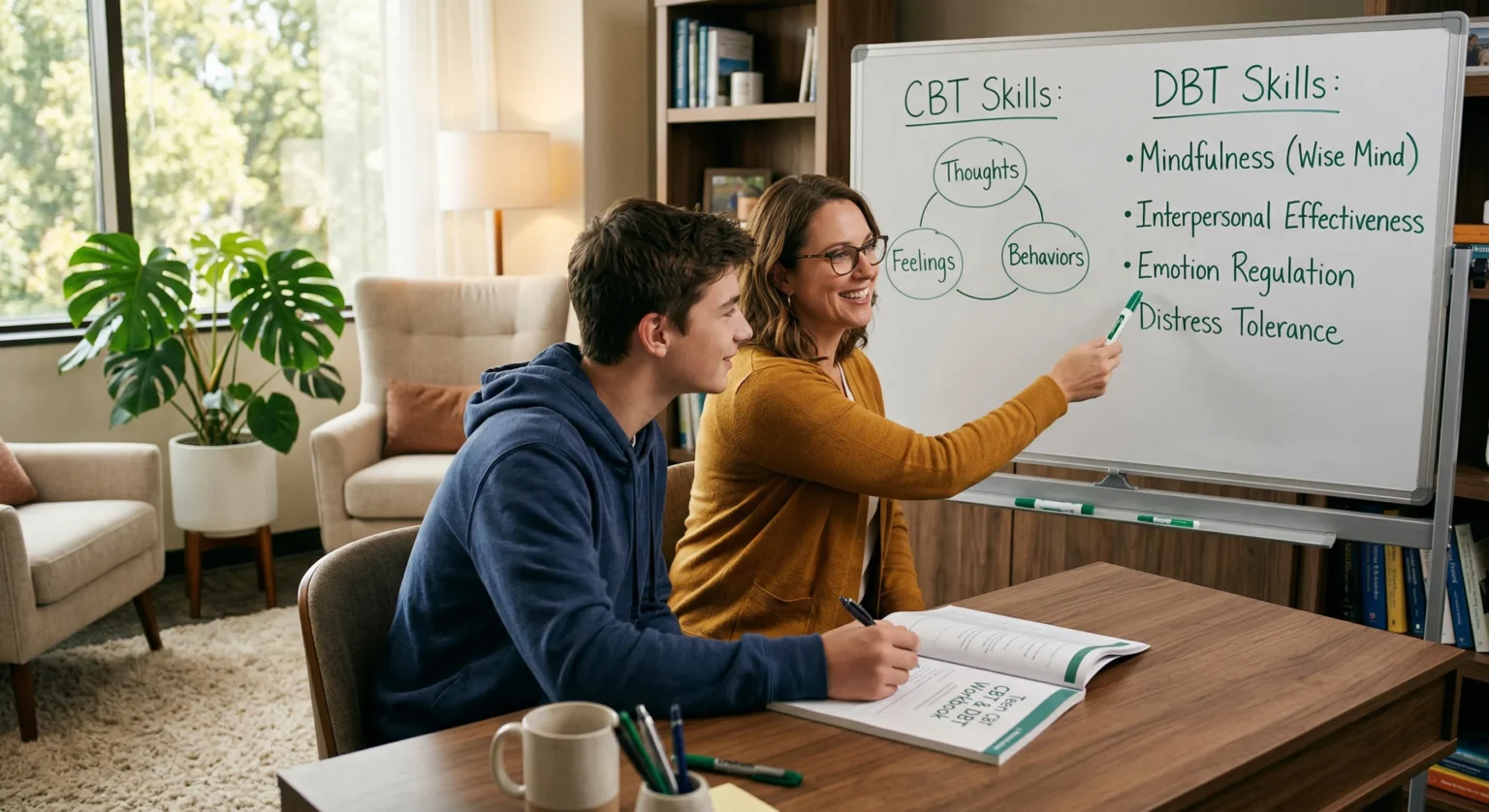
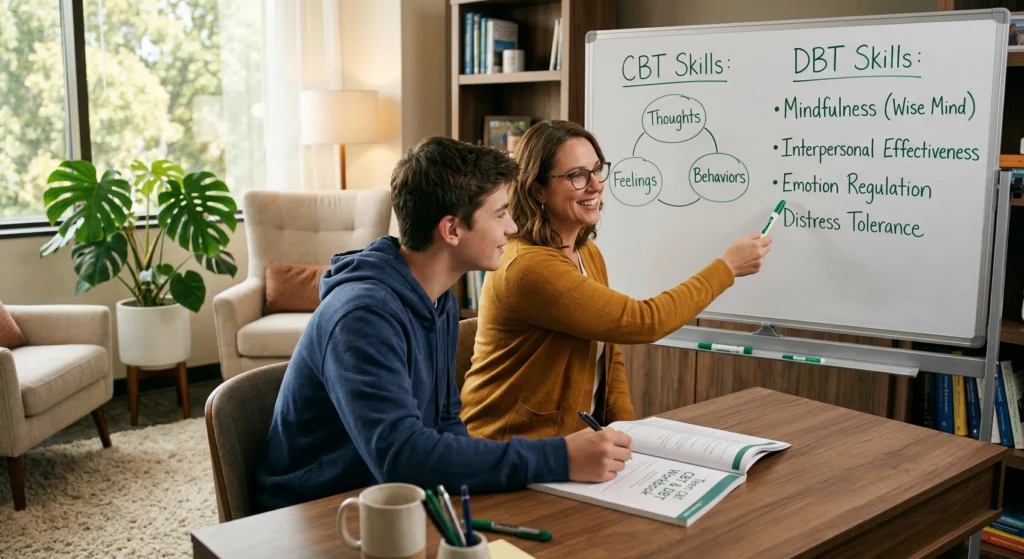
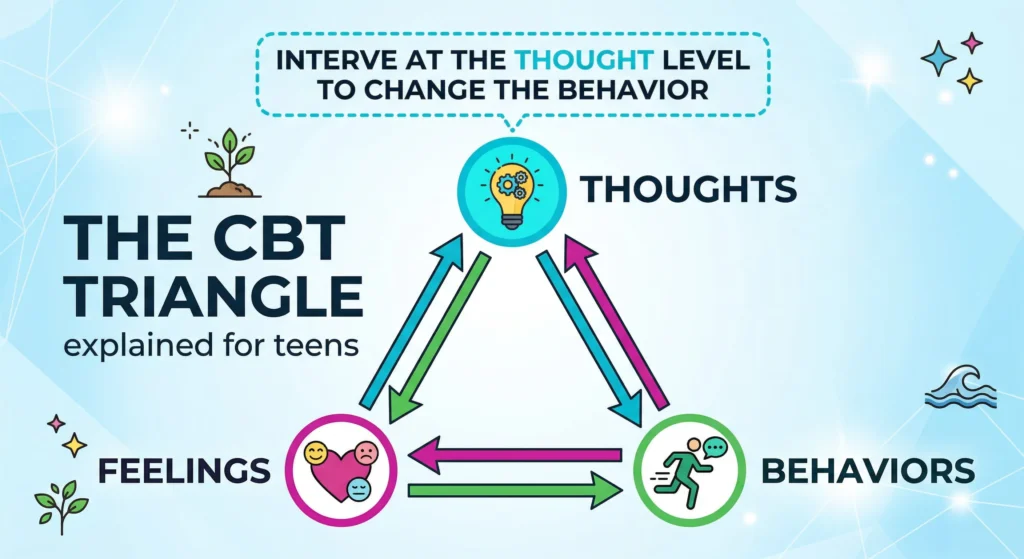
CBT operates on one fundamental principle: Your thoughts, your feelings, and your behaviors are all intimately connected. Most teens believe that external events cause their feelings. (e.g., “The math test made me panic.”) CBT teaches them that it is actually their interpretation of the event that causes the feeling.
- The Scenario: A teen walks down the hallway, says “Hi” to a friend, and the friend walks right past them without answering.
- The Automatic Thought: “They hate me. I did something wrong. I have no friends.”
- The Feeling: Intense shame and anxiety.
- The Behavior: The teen skips lunch, hides in the bathroom, and isolates for the rest of the week.
The CBT Intervention: In therapy, we do not try to change the feeling (you cannot force a teen to stop feeling anxious). We intervene at the Thought level.
We teach the teen to act like a detective and put that automatic thought on trial.
- “Is there any other evidence?” * “Could they have had their AirPods in? Could they be worried about their own math test?” By challenging the cognitive distortion, the thought changes. If the thought changes to, “They probably just didn’t hear me,” the feeling shifts from shame to neutral, and the behavior shifts from isolating to going to lunch.
Common "Cognitive Distortions" in Teens
At Teen Mental Health Facility, we help teens identify the “lies” their anxiety tells them. We call these cognitive distortions:
- Catastrophizing: Taking a small problem and assuming the absolute worst-case scenario. (“If I fail this quiz, my GPA will tank, I won’t get into college, and my life is over.”)
- Mind Reading: Assuming they know exactly what others are thinking about them, usually assuming it is negative.
- All-or-Nothing Thinking: Viewing situations in black and white. (“If I’m not the best player on the team, I am a total failure.”)
By learning to catch and reframe these thoughts, teens regain control over their internal narrative.
Section 3: Dialectical Behavior Therapy (DBT) Explained
While CBT is fantastic for the “worry loop” of anxiety, it sometimes falls short for teens who experience explosive rage, severe self-harm, or overwhelming emotional pain. Telling a teen who is actively having a panic attack to “put their thoughts on trial” is impossible; their logical brain is completely offline.
This is where Dialectical Behavior Therapy (DBT) shines.
Developed by Dr. Marsha Linehan, DBT was originally designed for borderline personality disorder but is now the gold standard for treating severe emotional dysregulation and self-injury in adolescents, as supported by Behavioral Tech (The Linehan Institute).
The Meaning of "Dialectical"
The word dialectical means balancing two opposing ideas at the exact same time. In DBT, those two ideas are Acceptance and Change.
- “I love and accept myself exactly as I am right now, AND I need to change my behaviors to build a life worth living.”
This is crucial for teens, who often feel deeply invalidated when adults tell them they need to “fix” their behavior. DBT validates their intense pain while demanding accountability for their actions.
Section 4: The 4 Pillars of DBT for Teens
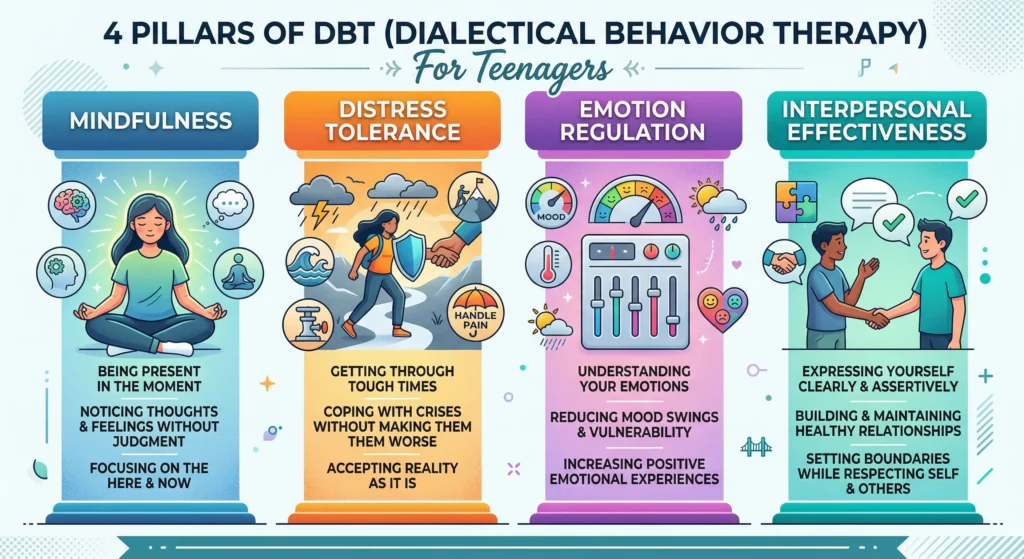
DBT is less about talking and more about learning an entirely new curriculum for life. We teach teens specific, actionable skills divided into four modules:
1. Mindfulness (The Anchor)
Before you can change an emotion, you have to realize you are having one. Mindfulness teaches teens to stay in the present moment without judgment. It moves them out of dwelling on the past (depression) or dreading the future (anxiety).
- The Skill: Learning to observe a feeling like a wave crashing on a beach—watching it rise, peak, and recede, without letting it pull them under.
2. Distress Tolerance (The Emergency Brake)
This is the most critical module for teens who engage in self-harm or substance abuse. Distress tolerance teaches teens how to survive a crisis without making it worse. We teach them that they can’t always control the pain, but they can control their reaction.
- The TIPP Skill: When emotions hit 100%, we use biology to hack the nervous system.
- T (Temperature): Holding an ice cube or splashing freezing water on the face triggers the “mammalian dive reflex,” instantly slowing the heart rate and stopping a panic attack.
- I (Intense Exercise): Doing 50 jumping jacks to burn off the adrenaline of rage.
- P (Paced Breathing): Exhaling longer than inhaling to signal safety to the vagus nerve.
- P (Paired Muscle Relaxation): Tensing and releasing muscle groups to expel stored trauma energy.
- T (Temperature): Holding an ice cube or splashing freezing water on the face triggers the “mammalian dive reflex,” instantly slowing the heart rate and stopping a panic attack.
- I (Intense Exercise): Doing 50 jumping jacks to burn off the adrenaline of rage.
- P (Paced Breathing): Exhaling longer than inhaling to signal safety to the vagus nerve.
- P (Paired Muscle Relaxation): Tensing and releasing muscle groups to expel stored trauma energy.
3. Emotion Regulation (The Thermostat)
Teens with mood disorders often feel like their emotions control them. This module teaches them how to become the master of their own thermostat.
- The Skill: “Opposite Action.” If depression tells a teen to isolate in their dark bedroom, the opposite action is to go sit in the bright living room. By doing the opposite of what the destructive emotion demands, they physically change the emotional outcome.
4. Interpersonal Effectiveness (The Boundary Builder)
Social anxiety and peer conflict are massive drivers of teen mental health crises. This module teaches them how to ask for what they need, how to say no, and how to navigate conflict without losing their self-respect.
- The DEAR MAN Skill: A step-by-step formula for having difficult conversations (Describe, Express, Assert, Reinforce, Mindful, Appear confident, Negotiate). It empowers them to stand up to peer pressure or communicate with parents without screaming.
Section 5: CBT vs. DBT: Which One Does My Teen Need?
Parents often ask which therapy is “better.” The truth is, they are two different tools for two different jobs, and at Teen Mental Health Facility, we integrate both based on the individual needs of your child.
- Choose CBT if: Your teen is struggling primarily with excessive worry, phobias, social anxiety, or negative self-esteem. CBT is perfect for the teen who is trapped in a cerebral “worry loop” and needs to learn how to untangle their distorted thoughts.
- Choose DBT if: Your teen is struggling with volatile mood swings, explosive anger, self-harm (cutting/burning), substance abuse, or chronic suicidal ideation. DBT is necessary when the teen’s emotions are so intense that they pose a threat to their own safety or relationships.
The Integrated Approach: Often, a teen will use DBT “Distress Tolerance” skills to survive a massive panic attack on Tuesday, and then use CBT “Cognitive Restructuring” on Wednesday to figure out why the panic attack happened in the first place. They work together perfectly.
Section 6: The "Homework" Factor (Why Practice is Crucial)
A common misconception about therapy is that the healing happens during the 50 minutes they spend in the clinician’s office.
Therapy is not a magic wand; it is a gymnasium. If you want to build a muscle, you cannot just read a book about lifting weights; you have to lift the weights. Similarly, if you want to build new neural pathways in the brain (neuroplasticity), your teen must practice these skills in the real world.
In both CBT and DBT, your teen will be given “Homework.”
- They might be asked to fill out a “Thought Record” when they feel anxious at school.
- They might be asked to practice their ice-water TIPP skill when they feel the urge to self-harm.
This practice is non-negotiable. It is what takes the therapy from an intellectual concept to a biological reality. The more they use the skills, the more automatic the skills become, eventually replacing the old, destructive coping mechanisms entirely.
Section 7: How Parents Can Support the Process
When your teen is learning CBT and DBT, the entire family ecosystem needs to shift to support them. You do not need to become their therapist, but you do need to become their coach.
According to the Child Mind Institute, parental involvement significantly increases the efficacy of behavioral therapies.
1. Learn the Language Familiarize yourself with the skills they are learning. If you see them spiraling, instead of saying “Calm down,” you can ask, “Do you think this is a time to use your TIPP skills? Do you want me to get you some ice?”
2. Validate First, Problem-Solve Second DBT emphasizes validation. When your teen comes to you upset about a friend, do not immediately try to fix it. Say, “It makes complete sense that you are angry about being left out. That hurts.” Once they feel heard, their nervous system will settle enough to actually use their CBT problem-solving skills.
3. Model the Skills Teens learn by watching. If you have a stressful day at work, narrate your own use of skills out loud. “I am feeling really overwhelmed right now, and I notice I’m catastrophizing about my deadline. I’m going to take five minutes to do some paced breathing before I make dinner.” Showing them that adults use these tools normalizes the process.

Section 8: Levels of Care at Teen Mental Health Facility
Learning CBT and DBT is like learning a new language. If your teen is in a severe crisis, trying to learn these skills in a weekly 50-minute outpatient session is often not enough. They need immersion.
At Teen Mental Health Facility, we offer structured environments where teens are steeped in these modalities for hours a day.
- Intensive Outpatient Program (IOP): Teens attend therapy for 3 hours a day, 3-4 days a week after school. This is highly effective because they learn the skills in a group setting and practice them with peers.
- Partial Hospitalization Program (PHP): A full-day program that temporarily replaces school. Ideal for teens whose anxiety or depression is so severe that they are engaging in school refusal or active self-harm. We provide intense daily DBT skills training and psychiatric stabilization.
- Residential Treatment: 24/7 immersive care. Necessary for teens whose environment is triggering them, or who need complete removal from their daily life to focus 100% on rewiring their behavioral responses.
Read more about finding the right fit on our Treatment Programs page.
Conclusion: Equipping Them for the Future
Adolescence is not supposed to be a daily battle for survival.
If your teen is drowning in a sea of anxiety or explosive emotions, they don’t need a lecture, and they don’t need to “just toughen up.” They need a lifeboat.
CBT and DBT are that lifeboat. These therapies do not just put a band-aid on the symptoms; they give your teenager an owner’s manual for their own brain. They teach them that while they cannot control the world, they have absolute, unbreakable control over how they respond to it.
By investing in evidence-based therapy now, you are not just helping them survive high school; you are giving them the emotional armor they will use to succeed in college, careers, and relationships for the rest of their lives.
If you are ready to give your child the tools they need to reclaim their life, contact the admissions team at Teen Mental Health Facility today for a free, confidential clinical assessment.
Frequently Asked Questions (FAQs)
How long does it take for CBT or DBT to work? Because these are skill-based therapies, they are considered “active” and often yield faster results than traditional talk therapy. Many teens notice a reduction in symptom severity within 8 to 12 weeks of an Intensive Outpatient Program (IOP), provided they are consistently doing the “homework” and practicing the skills.
Is my teen going to feel like they are “in school” during therapy? While DBT and CBT are structured and involve learning concepts, our clinicians specialize in adolescents. We make the learning experiential. We use games, role-playing, art, and peer interaction to teach the skills, ensuring it never feels like a boring lecture.
Do parents participate in DBT? Yes. In comprehensive DBT programs, family involvement is crucial. We often provide multi-family skills groups where parents learn the exact same distress tolerance and communication skills the teens are learning, ensuring the whole household speaks the same emotional language.
Can my teen do CBT/DBT if they are already on medication? Absolutely. In fact, clinical research shows that the combination of psychiatric medication (to stabilize the biological brain chemistry) and behavioral therapy (to build the psychological coping skills) is the most effective treatment protocol for severe anxiety and mood disorders.