


What to Do If Your Teen Refuses Mental Health Treatment: A Parent’s Survival Guide
Medical Disclaimer: The content provided in this article is for informational purposes only and does not constitute medical or legal advice. If your teen is actively self-harming, expressing suicidal ideation, experiencing psychosis, or poses an immediate threat to themselves or others, their refusal is superseded by the need for immediate medical safety. Please call 988 or go to the nearest emergency room immediately. For confidential guidance on intervention and admissions, contact Teen Mental Health Facility.
Introduction: The Ultimate Standoff
It is the most paralyzing standoff a parent can face.
You have seen the signs. You have watched the light fade from your teenager’s eyes. You have noticed the sudden drop in grades, the mysterious withdrawal from their friends, the explosive rage over minor inconveniences, or the terrifying discovery of a vape pen or self-harm scars.
You do the hardest part: You confront the issue. You approach them with love, offering to get them professional help, a therapist, or a treatment program to help them feel better.
And they look at you with pure defiance, panic, or apathy, and say:
“I’m not going. I’m fine. Therapy is stupid. You can’t make me.”
Then, the door slams.
In that moment, you feel utterly helpless. You are caught between the desperate biological urge to save your child and the terrifying reality that your child is nearly adult-sized, fiercely independent, and actively refusing the life raft you are throwing them. You worry that forcing them will ruin your relationship forever, but you know that doing nothing might cost them their life.
At Teen Mental Health Facility, we want you to take a deep breath. You are not powerless, and your teen’s “No” is not the end of the conversation.
Adolescent resistance to mental health treatment is not the exception; it is the rule. It is a completely normal psychological defense mechanism. In this comprehensive guide, we will decode the neuroscience behind why your teen is refusing help, teach you how to bypass their defensive armor using clinical communication strategies, and explain how to establish non-negotiable boundaries that gently guide them into the care they desperately need.
If you are stuck in this standoff and need professional guidance, explore our Teen Treatment Programs at Teen Mental Health Facility to learn how we handle resistant adolescents.

Section 1: The Neuroscience of "No" (Why They Refuse)
To overcome your teen’s resistance, you must first understand what is driving it. When a teenager screams, “I don’t need therapy!” they are rarely telling the truth. What they are actually expressing is a complex knot of fear, shame, and biological development.
According to the Child Mind Institute, adolescent resistance to treatment usually stems from one of four core psychological drivers:
1. The Threat to Autonomy
The primary developmental job of a teenager is to individuate—to separate from their parents and establish their own identity. When a parent says, “You need therapy,” the teen’s Amygdala (the brain’s threat-detection center) interprets this as an attack on their independence. To their developing brain, accepting help feels like admitting they are still a child who needs to be “fixed” by an adult.
2. The Stigma and Shame
Despite massive strides in mental health awareness, the middle school and high school hallways can still be brutal. Your teen may be terrified of the “crazy” label. They worry that if they go to a treatment program or a therapist, it confirms their deepest, darkest fear: I am fundamentally broken, and everyone is going to know.
3. The Fear of Vulnerability (The "Vulnerability Hangover")
Therapy requires opening up. For a teen who has been using anger, apathy, or substances as a shield to survive their own mind, taking off that armor is terrifying. They are protecting their wounds. Refusing treatment is their way of saying, “I am not ready to let a stranger see how much pain I am in.”
4. Anosognosia (Lack of Insight)
In cases of severe depression, substance use disorders, or emerging mood disorders, the brain actually tricks itself. The depression convinces them that “nothing will help anyway.” The addiction convinces them that “I can stop whenever I want.” This lack of clinical insight means they genuinely cannot perceive how sick they are.
Section 2: The "Wait and See" Trap
When faced with a screaming, resistant teenager, many parents choose to retreat.
You think: “If I force them, they’ll just sit in the therapist’s office in silence. It will be a waste of money. I don’t want them to hate me. Let’s just wait and see if things calm down.”
This is the most dangerous trap a parent can fall into.
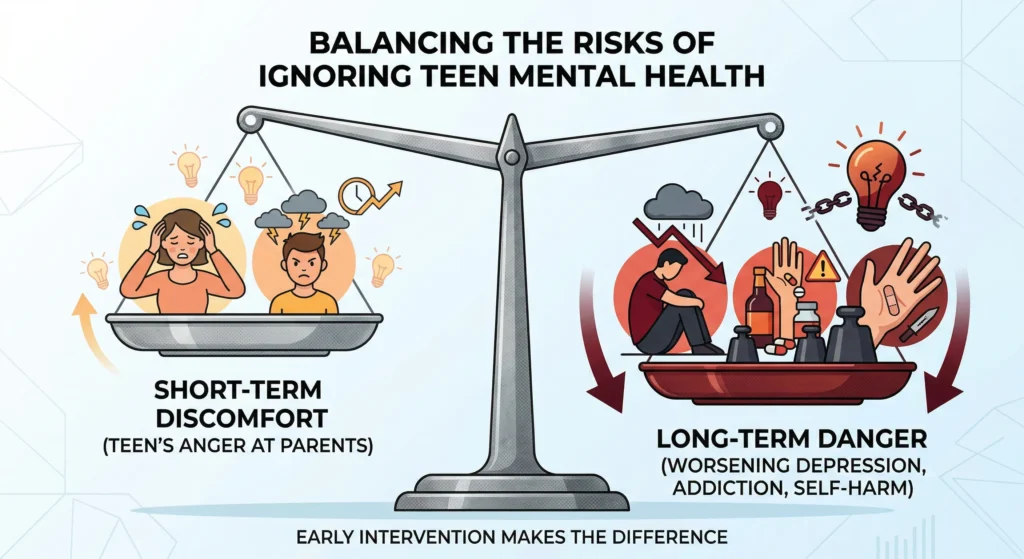
Mental health disorders are progressive. A broken bone does not heal itself if you ignore it, and neither does a dysregulated nervous system.
- The Reality of Enabling: When you back down from your requirement for treatment because your teen threw a tantrum, you are inadvertently teaching them that their anger is an effective tool to avoid dealing with their problems.
- The Cost of Waiting: The longer depression, anxiety, or substance abuse goes untreated, the more entrenched the neural pathways become. What could have been resolved with an Intensive Outpatient Program (IOP) this year might require long-term Residential Treatment next year.
Your job is to be their prefrontal cortex—their executive decision-maker—when theirs is offline. Prioritize their long-term survival over their short-term approval.
Section 3: Changing the Conversation (Scripts for Parents)
If you approach your teen with panic, accusations, or ultimatums, they will match your energy with defiance. To bypass their armor, you must change your approach.
Clinicians often recommend the LEAP Method (Listen, Empathize, Agree, Partner) for resistant individuals. Here is how to apply it in your living room:
1. Drop the Labels
Do not say, “You are depressed,” or “You have an anxiety problem.” Teens will fight the label. Instead, focus entirely on the observable symptoms that are bothering them.
- Try This: “I’ve noticed you haven’t been sleeping well lately, and you seem really stressed about your grades. I know how exhausting that is.”
2. Validate the Resistance
Acknowledge their fear out loud. This disarms them. If you agree with their hesitation, they have nothing to fight against.
- Try This: “I know you think therapy is stupid. I honestly get it. It is incredibly weird to sit in a room and talk to a stranger about your life. I would be skeptical, too.”
3. The "Trial Run" Compromise
Teens are terrified of forever. The idea of “going to treatment” sounds like a life sentence. Give them an out.
- Try This: “I am not asking you to go to therapy forever. I am asking you to commit to 4 sessions. If, after 4 sessions, you think this specific therapist is a terrible fit, we will fire them. But you have to give it an honest try first. Deal?”
4. The "Car Ride" Strategy
Never have this conversation face-to-face across a kitchen table. That feels like an interrogation. Have the conversation while driving in the car. The lack of direct eye contact removes the pressure, and the forward motion helps process adrenaline, making them far more likely to open up.
Section 4: Utilizing Leverage and Boundaries
If compassionate conversation fails and your teen gives a hard, non-negotiable “No,” it is time to use leverage.
As a parent, you control the ecosystem of the house. You provide the privileges that your teen enjoys. Privileges must be tied to health and safety.
This is not about “punishing” them for being depressed; it is about establishing a boundary that you will not fund or facilitate a lifestyle where they are destroying themselves.
How to Set a Health Boundary:
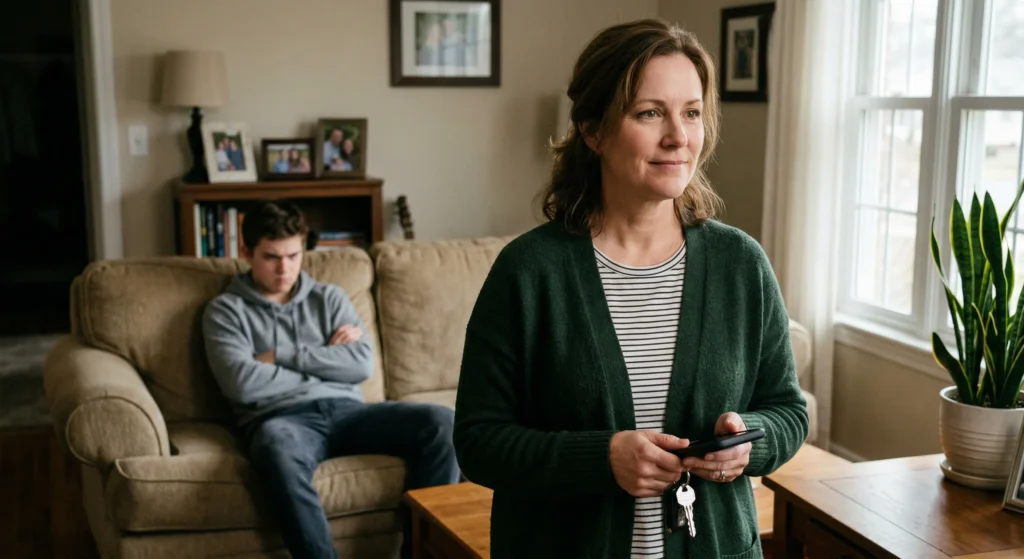
- “I love you unconditionally, and my number one job is to keep you safe. Right now, you are not safe. Your mental health is declining. Because you are refusing to see a professional, I cannot in good conscience let you take the car on weekends. Driving is a privilege for healthy, focused individuals. When you agree to start an assessment, we can discuss the car keys again.”
- “We pay for your smartphone and your data plan. Constant social media is clearly making your anxiety worse. Until you agree to speak with a counselor to get some tools to manage this stress, the smartphone stays in my room at 8 PM every night.”
The Extinction Burst: When you set this boundary, they will explode. They will scream that you are ruining their life. Hold the line. When they realize you will not cave, the resistance will eventually break.
Section 5: "What if they just sit there and don't talk?"
This is the greatest fear parents have when “forcing” a teen into treatment. You worry you are wasting thousands of dollars for your kid to give a therapist the silent treatment for an hour.
Trust the professionals. We are highly trained for this.
At Teen Mental Health Facility, our clinicians do not expect a teenager to walk in on Day 1 and pour their heart out. We expect resistance. We welcome it.
Here is what actually happens behind closed doors with a resistant teen:
- The “No-Pressure” Zone: The therapist might say, “Your mom made you come here, huh? That sucks. You don’t have to talk to me about your feelings today if you don’t want to.” Instantly, the power struggle evaporates.
- Activity-Based Therapy: We don’t just stare at them. We play cards, shoot hoops, or do art therapy. We distract the defensive part of their brain with an activity.
- Building the Alliance: It may take three or four sessions of just talking about video games or their favorite music before the clinical work begins. Once the “Therapeutic Alliance” is built—once the teen realizes the therapist is not just an extension of their parents—the floodgates usually open.
Section 6: When Safety Trumps Consent (The Legal Reality)
There is a distinct line between a teen who is resistant to talking about their social anxiety, and a teen who is in active, life-threatening danger.
If your teen is engaging in severe self-harm, expressing suicidal plans, suffering from an eating disorder that threatens their heart, or using illicit drugs (like fentanyl or meth), their consent is no longer required.
According to the American Academy of Child and Adolescent Psychiatry (AACAP), parents have the legal and moral authority to consent to life-saving medical treatment for their minor children, regardless of the child’s protests.
In these acute crises, you do not ask; you tell.
- “You are sick. I love you too much to let you die. We are going to the hospital/treatment center right now.”
If they become violent or attempt to run away, you can utilize professional transport services or local crisis intervention teams who specialize in safely escorting adolescents to psychiatric facilities. It is terrifying, but it saves lives.
Section 7: The "Parent-First" Approach (When They Still Say No)
If your teen is not in immediate physical danger (e.g., they are just highly anxious, isolating, and refusing to leave their room) and they absolutely refuse to get out of the car or walk into the clinic, what do you do?
You go to therapy.
Family Systems Theory dictates that a family is like a mobile hanging over a crib. If you move one piece, all the other pieces move in response. If your teen refuses treatment, you and your spouse enroll in Parent Coaching or Family Therapy without them.
- The Strategy: You work with our clinicians to change how you react to the teen. You learn how to stop enabling their anxiety, how to set iron-clad boundaries, and how to stop walking on eggshells.
- The Result: When the parents change the ecosystem of the house, the teen is forced to adapt. Often, when the teen sees the parents getting support and changing the rules of engagement, their resistance crumbles, and they eventually agree to join the sessions.

Exploring Levels of Care
If a weekly therapy session isn’t enough to break through the resistance, or if their symptoms are too severe, you must explore higher levels of care. Removing them from their standard environment is often the “pattern interrupt” needed to break the defiance.
- Intensive Outpatient Program (IOP): 3-4 days a week after school. This is highly effective because it introduces Peer Validation. A resistant teen might ignore an adult therapist, but when they sit in a group therapy circle with other cool, smart teenagers who say, “Yeah, I have panic attacks too,” the resistance melts away.
- Partial Hospitalization Program (PHP): A full-day program that temporarily replaces school. Ideal for teens refusing to go to school due to severe depression or anxiety.
- Residential Treatment: 24/7 immersive care. Necessary for teens whose home environment has become a daily battleground, or those who are an active danger to themselves.
Read more about finding the right fit on our Treatment Programs page.
Conclusion: You Are the Executive Function
Parenting a teenager in crisis is the hardest job in the world. When they look at you with anger and scream that they hate you for forcing them into treatment, it breaks your heart.
But you must remember: That is the disease talking, not your child.
Your child is trapped in a burning building, and the smoke is blinding them to the exit. You cannot wait for them to find the door on their own. You have to walk in, grab their hand, and pull them out, even if they fight you the whole way.
Someday, when their brain chemistry has stabilized, when the dark cloud has lifted, and they have their life back, they will look back on this moment. They won’t remember that they were mad at you. They will remember that when they were at their absolute worst, you did not give up on them. You fought for their life when they couldn’t.
You are the parent. You can do hard things. We are here to help you do them.
If you are ready to break the standoff, contact the admissions team at Teen Mental Health Facility today for a confidential consultation on how to safely intervene.
Frequently Asked Questions (FAQs)
What if my teen is 18 but still lives at home and refuses help? Once a child turns 18, they are a legal adult, and you cannot force them into treatment unless they meet the criteria for an involuntary psychiatric hold (danger to self/others). However, you can enforce boundaries regarding what you will financially support. You can make their living in your home, using your car, or receiving your financial help strictly conditional on their active participation in a treatment program.
Should I trick my teen into going to therapy? No. Never tell your teen you are going for ice cream and pull up to a therapist’s office. This destroys the foundation of trust, which is essential for therapy to work. Be honest, be firm, and do not negotiate the outcome, but do not lie about the destination.
Can the school help me get them into treatment? Yes. School counselors can be powerful allies. Sometimes a teen will listen to a respected coach, teacher, or counselor when they won’t listen to a parent. You can also utilize 504 plans or IEP meetings to formally document how their mental health is impacting their education, creating a unified front between the family and the school.
What if they hate the therapist I choose? A “Therapeutic Alliance” is critical for success. We recommend the “3-Session Rule.” Tell your teen they must give the therapist three honest sessions. If they still feel completely unheard or mismatched after three sessions, validate their feelings and work with them to choose a different clinician. This gives them a sense of agency in their own recovery.