


Teen Depression Treatment in Orange County: What to Expect and How to Prepare
Medical Disclaimer: The content provided in this article is for informational purposes only and does not constitute medical advice. Teen depression is a serious medical condition that carries a risk of self-harm and suicide. If your teen is expressing hopelessness, giving away possessions, or talking about death, please call 988 or go to the nearest emergency room immediately. For confidential assessment and admissions, contact Teen Mental Health Facility.
Introduction: The Contrast of the Coast
Living in Orange County, California, presents a unique paradox for families. We are surrounded by almost perpetual sunshine, beautiful coastlines from Huntington Beach to San Clemente, and communities designed for a high quality of life. From the outside, it looks like a paradise for raising children.
But as a parent, you know that sunshine doesn’t cure a neurobiological disorder.
If your teenager is struggling with clinical depression, the contrast between the beautiful, high-achieving environment of Orange County and the dark, heavy reality inside your home can feel incredibly isolating. You might look at your child—who has access to great schools, extracurriculars, and a loving family—and ask yourself in quiet desperation: “We gave them everything. Why are they so unhappy?”
First, let go of the guilt. Depression is not a lack of gratitude, and it is not a parenting failure.
According to the National Institute of Mental Health (NIMH), major depressive episodes are alarmingly common among adolescents, affecting millions of teens regardless of their socioeconomic status. In hyper-competitive environments like Orange County, the pressure to excel academically, athletically, and socially often acts as an accelerant for underlying mental health vulnerabilities.
When you finally realize that your teen’s “moodiness” has crossed the line into a clinical crisis, the next step is seeking help. But the idea of “treatment” is terrifying. Parents often picture cold hospitals or imagine their child sitting silently on a couch while a stranger judges their family.
At Teen Mental Health Facility, we want to demystify the recovery process. In this comprehensive guide, we will walk you step-by-step through what teen depression treatment actually looks like in Orange County, from the first phone call to the final discharge, so you and your teen know exactly what to expect.
If you are ready to take the first step toward healing, explore our Teen Treatment Programs at Teen Mental Health Facility today.

Phase 1: The Orange County Pressure Cooker (Why They Need Help)
Before we explain the treatment, it helps to understand exactly what we are treating. Teen depression in Orange County often looks very different from the classic symptoms of lethargy and crying.
Here, we frequently treat High-Functioning Depression and Burnout.
The "Perfect Resume" Trap
Teens in districts across Irvine, Newport-Mesa, and Capistrano Unified are under immense pressure to build the “perfect” college resume. They are balancing AP classes, club sports, and volunteer work. When depression hits a high-achiever, they don’t always fail their classes. Instead, they become brittle. Their depression masks itself as intense perfectionism. They are terrified that if they stop moving, they will shatter. They use anxiety and adrenaline as fuel until their nervous system completely collapses.
The Social Media Mirage
Our teens are growing up in the epicenter of influencer culture. They are constantly bombarded with curated, filtered highlight reels of their peers. This constant social comparison triggers a deep, pervasive sense of inadequacy—a core belief that “I am not enough.”
Treatment isn’t just about giving them an antidepressant; it is about systematically dismantling these toxic belief systems and teaching them how to survive in a high-pressure world without losing their soul.
Phase 2: The First Step (Intake and Assessment)
The fear of the unknown keeps many families from making the first call. You might wonder, “Will they lock my kid up? Will social services be called? What if my teen refuses to talk?”
Here is what actually happens during the admissions process at Teen Mental Health Facility:
The Admissions Call
Your first contact is with a compassionate admissions coordinator, not a rigid hospital administrator. This call is for you, the parent. We listen to your story, gather basic medical history, and verify your insurance benefits. We know you are exhausted, and our goal is to take the logistical burden off your plate immediately.
The Bio-Psycho-Social Assessment
Once admitted, your teen will undergo a comprehensive assessment with our clinical team. This is not an interrogation. It is a gentle, conversational “Vibe Check.” We look at three specific areas:
- Biology: Is there a family history of depression? Are there sleep issues or nutritional deficits? We evaluate if psychiatric medication might be a helpful tool.
- Psychology: How does your teen view themselves? Is there a history of trauma, bullying, or self-harm?
- Sociology: What is their home environment like? Are their friendships supportive or toxic? Are they self-medicating with vaping or alcohol?
This complete picture allows us to build a Customized Treatment Plan. We do not use a cookie-cutter approach.
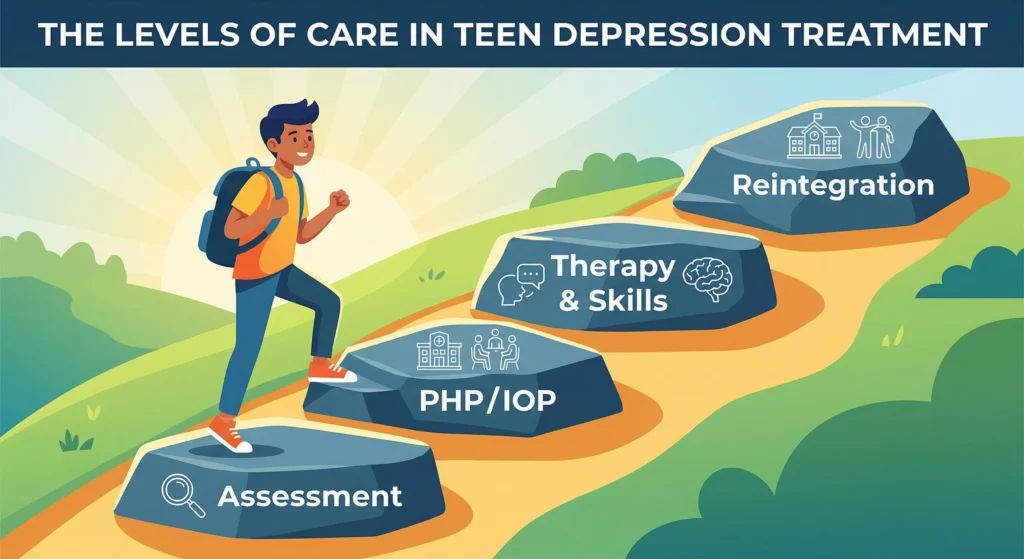
Phase 3: Choosing the Right Level of Care
One of the greatest benefits of modern mental health treatment is that you don’t necessarily have to send your child away to a wilderness camp or a locked ward. We offer a continuum of care designed to integrate with your teen’s real life in Orange County.
Intensive Outpatient Program (IOP)
- What to Expect: Your teen attends therapy at our facility for roughly 3 hours a day, 3 to 4 days a week, typically after school.
- Who it is for: Teens who are struggling with depression but are still able to attend school and remain safe at home. It provides a robust clinical safety net while allowing them to sleep in their own bed and maintain some normalcy.
Partial Hospitalization Program (PHP)
- What to Expect: Often called “Day Treatment,” PHP runs for about 6 hours a day, 5 days a week. It serves as a temporary replacement for traditional school. We provide academic coordination to ensure they don’t fall behind while they focus intensely on psychiatric stabilization.
- Who it is for: Teens who are experiencing severe school refusal, self-harming behaviors, or debilitating depressive episodes that make functioning in a massive high school impossible.
Residential Treatment
- What to Expect: 24/7 immersive care in a home-like, highly structured environment.
- Who it is for: Teens who are an immediate danger to themselves, those suffering from severe co-occurring substance use disorders, or those who cannot break the cycle of depression in their current home environment.
Phase 4: Inside the Therapy Room (The Actual Work)
Parents often ask, “What are they doing in there for three hours a day?” Teen therapy is not like adult therapy. Teens do not want to sit on a leather couch and analyze their early childhood. They need active, engaging, and practical interventions.
Cognitive Behavioral Therapy (CBT)
Depression lies. It tells your teen: “You are worthless. Everyone hates you. You will never get into a good college. Nothing matters.” In CBT, we teach teens to act like lawyers in their own minds. We teach them to put those “Automatic Negative Thoughts” on trial, demand evidence, and reframe them into realistic, neutral truths. We rewire the cognitive distortions that fuel their despair.
Dialectical Behavior Therapy (DBT)
For teens who feel emotions at 110% intensity and use self-harm or isolation to cope, DBT is a lifesaver. We teach them concrete Distress Tolerance skills. What do you do when you are having a panic attack in the school bathroom? We teach them how to use temperature (like holding an ice cube) to manually reset their nervous system and drop their heart rate. We give them a tangible toolkit for survival.
Experiential and Somatic Therapy
Because Orange County offers an incredible environment, we don’t confine healing to a clinic. We use Experiential Therapy—such as art therapy, music therapy, and outdoor recreation. Sometimes, a teen who refuses to make eye contact with a therapist will spill their entire heart out while painting a canvas or walking on a trail. We engage the body to heal the mind.
Phase 5: The Role of Psychiatric Medication
This is often the most anxiety-inducing topic for parents. “Will you put my kid on pills? Will it change their personality?”
According to the American Academy of Child and Adolescent Psychiatry (AACAP), the most effective treatment for moderate to severe adolescent depression is a combination of psychotherapy and medication.
Here is our philosophy on medication:
- It is a tool, not a cure. Antidepressants (like SSRIs) do not “fix” the teenager. They provide a biological “floor.” When a teen is profoundly depressed, their brain is so depleted of serotonin that talk therapy cannot gain traction. Medication turns the volume of the depression down from a 10 to a 4, allowing the teen to actually engage in therapy and learn coping skills.
- It is a collaborative choice. Our board-certified adolescent psychiatrists work with you and your teen. We explain the science, the potential side effects, and the timeline. You are always in the driver’s seat regarding your child’s medical care.
- It doesn’t have to be forever. For many teens, medication is a temporary bridge used to stabilize their brain chemistry during a developmental crisis.

Phase 6: Healing the Family Ecosystem
You cannot treat a teenager in a vacuum and then send them back into an unchanged environment. When a child is severely depressed, the entire family system becomes sick. Parents become hyper-vigilant, siblings feel ignored, and the home turns into a minefield of walking on eggshells.
At Teen Mental Health Facility, Family Therapy is mandatory.
Parent Coaching: From "Fixer" to "Validator"
As a parent, your instinct is to fix the problem. When your teen says, “I’m so stressed about my finals, I feel like a failure,” your instinct is to say, “Don’t be silly, you’re so smart, you’ll do great!” While well-intentioned, this is deeply invalidating to a depressed brain. It tells them their feelings are wrong.
We train parents in the art of Validation. We teach you to say, “I hear how overwhelmed you are. That sounds incredibly heavy. I am right here with you.” We teach you how to set firm boundaries with love, how to communicate without triggering a defensive shutdown, and how to rebuild the trust that depression has eroded.
The "Messy Middle": What Parents Need to Know
We must be honest with you: Recovery is not a straight, upward line.
There is a phase in treatment we call the “Messy Middle.” When a teen first enters an IOP or PHP, they often experience a “Vulnerability Hangover.” For the first time, their emotional armor has been stripped away. They are feeling feelings they have suppressed for years.
During weeks 2 or 3 of treatment, your teen might actually seem more irritable or exhausted. They might say they hate the program and want to quit. This is an extinction burst. It means the therapy is working. The disease of depression is fighting back because it is losing control.
Your job as a parent during the Messy Middle is to hold the line. Do not pull them out of treatment because it is hard. Trust the clinical team. The breakthrough almost always happens right after the breakdown.

Reintegration: Returning to the "Real World"
The ultimate goal of treatment is not to keep your teen in therapy forever; it is to give them the tools to graduate from it.
As your teen stabilizes, we begin the Discharge Planning process early.
- If they are in PHP, we step them down to IOP, gradually reintegrating them into their regular high school.
- We coordinate with their school’s guidance counselors to establish a 504 Plan or IEP if necessary, ensuring they have legal accommodations (like extended testing time or permission to leave class if they have a panic attack) to prevent academic burnout.
- We connect them with a long-term outpatient therapist and psychiatrist in the Orange County community for ongoing maintenance.
We do not just drop them off a cliff; we build a sturdy bridge back to their life.
Conclusion: The Light Can Return
When you are in the thick of it, teen depression feels like a permanent state of being. The despair lies to you, convincing you that your bright, capable child is gone forever.
They are not gone. They are just buried under a neurobiological storm.
We see miracles happen in our facility every single day. We see the teen who refused to make eye contact on day one slowly start laughing in group therapy. We see the straight-A student realize their worth is not tied to their GPA. We see families who haven’t had a peaceful dinner in years finally learn how to talk to each other again.
Treatment works. The teenage brain is incredibly resilient and capable of massive rewiring.
You do not have to watch your child suffer in silence anymore. You are not alone in this fight. If you are ready to help your teen find their way out of the dark, contact the compassionate admissions team at Teen Mental Health Facility today for a free, confidential clinical assessment.
Frequently Asked Questions (FAQs)
Will my teen fall behind in school if they go to a PHP or IOP? No. Our PHP program includes dedicated, supervised academic hours to ensure students stay caught up with their coursework. We act as a liaison with their Orange County high school to manage their workload. Our IOP program takes place after school hours, specifically designed not to interfere with their standard academic day.
What if my teen flat-out refuses to go to treatment? This is incredibly common. Depression tells them that treatment won’t work and that avoiding it is safer. As a parent, you have the legal right and responsibility to consent to medical treatment for your minor child. Our clinical team can coach you on how to have a firm, loving, “non-negotiable” conversation to get them through the door.
Are group therapy sessions safe? Won’t they just learn bad behaviors from other teens? This is a common fear, but the reality is the opposite. Our groups are heavily moderated by licensed clinicians who maintain strict behavioral boundaries. Isolation is the greatest danger of depression. When a teen sits in a room with other high-functioning, “normal” kids who are fighting the exact same invisible battle, the shame evaporates. Peer validation is often the turning point in recovery.
How long does a typical treatment program last? Because we provide individualized care, there is no set timeline. However, a typical stay in an IOP or PHP ranges from 6 to 12 weeks. The goal is to ensure they have fully mastered their coping skills and are neurologically stable before stepping down to lower levels of care.