

Medical Disclaimer: The content provided in this article is for informational purposes only and does not constitute medical or legal advice. If your teen is actively self-harming, expressing suicidal ideation, experiencing psychosis, or poses an immediate threat to themselves or others, please call 988 or go to the nearest emergency room immediately. For confidential guidance on clinical care and admissions, contact Teen Mental Health Facility.
Introduction: The Agonizing Decision
There is perhaps no decision more agonizing for a parent than deciding whether to send their child to a mental health facility.
You lie awake at night running through a terrifying loop of questions: “Am I overreacting?” “Will sending them away traumatize them?” “Will they hate me forever for making this choice?” “What if I don’t send them, and something terrible happens?”
You likely started with the standard steps. You noticed your teen withdrawing, so you tried to talk to them. When they shut you out, you found a local therapist for them to see once a week. You hoped that 50 minutes of talking every Tuesday would be enough to lift the dark cloud of depression, stop the panic attacks, or end the sudden, explosive rage.
But the cloud hasn’t lifted. In fact, the storm is getting worse.
At Teen Mental Health Facility, we talk to heartbroken, exhausted parents at this exact crossroads every single day. We want to start by validating your fear: It is completely normal to be terrified of the word “facility.” But we also want to validate your intuition: If your gut is telling you that your child is slipping away and a weekly therapy appointment isn’t throwing them a big enough life raft, you are probably right.
In this comprehensive guide, we will help you eliminate the guesswork. We will break down the clear, undeniable signs that your teen requires a higher level of clinical care, demystify what modern mental health treatment actually looks like, and help you overcome the “Parent Guilt” trap so you can save your child’s life.
If you are ready to explore the next steps, discover our Teen Treatment Programs at Teen Mental Health Facility.
Section 1: Normal Teen Angst vs. Clinical Crisis
The teenage brain is a construction zone. The emotional center (the Amygdala) is hyper-active, while the logical control center (the Prefrontal Cortex) is still under development. Because of this, all teenagers will experience mood swings, boundary-pushing, and moments of intense frustration.
To know if it is time for a facility, we don’t just look at the emotion; we look at the Functional Impairment.
Functional impairment means that the mental health issue is no longer just a feeling—it is actively destroying their ability to live a normal life.
The “Wait and See” Trap: Many parents delay intensive treatment because they hope the teen will “grow out of it.” But neurobiological disorders like severe clinical depression, generalized anxiety disorder, and trauma do not cure themselves. According to the National Institute of Mental Health (NIMH), ignoring severe symptoms during adolescence allows destructive neural pathways to become deeply entrenched, making recovery much harder in adulthood.
Section 2: The Red Flags: When Weekly Therapy Isn’t Enough
If your teen is currently seeing a weekly outpatient therapist but you are observing the following signs, it is a clear indicator that 50 minutes a week is insufficient to keep them safe. They need the robust, multi-day scaffolding of an intensive program.
1. Severe School Refusal and Academic Collapse
This is not just “skipping class to hang out with friends.” This is a teen who physically cannot get out of bed to go to school due to paralyzing panic attacks or profound depressive lethargy.
- The Sign: They accumulate weeks of absences, their GPA plummets from A’s to F’s, and the mere mention of school induces vomiting, rage, or a total shutdown.
2. Escalating Self-Harm (NSSI)
Non-Suicidal Self-Injury (cutting, burning, scratching) is a maladaptive coping mechanism used to release intense emotional pressure.
- The Sign: The self-harm is becoming more frequent, the wounds are becoming deeper, or they are cutting in highly dangerous areas. If they cannot stop despite wanting to, or if they promise their weekly therapist they will stop but immediately relapse, they require an environment where sharps are restricted and distress tolerance skills are taught daily.
3. Substance Abuse as Self-Medication
If you are finding vape pens, empty alcohol bottles, or prescription pills hidden in their room, they are likely attempting to self-medicate their underlying anxiety or trauma.
- The Sign: They react with terrifying, disproportionate rage when you confiscate the substance. This indicates a chemical dependency. A weekly therapist cannot safely monitor detox or break a daily addiction cycle; an intensive facility is required.
4. Active Suicidal Ideation or Planning
This is the absolute loudest alarm bell.
- The Sign: Giving away prized possessions, saying things like “Everyone would be better off without me,” or discovering that they have researched methods of suicide online.
- The Reality: According to the Centers for Disease Control and Prevention (CDC), suicide is the second leading cause of death for youth. If your teen is actively suicidal, their safety supersedes everything else, including their school attendance or their temporary anger at you for intervening.
Section 3: Demystifying the “Mental Health Facility”
For many parents, the term “Mental Health Facility” conjures terrifying images from movies: sterile white walls, locked wards, or punitive “troubled teen” boot camps in the wilderness.
Erase those images from your mind.
Modern, high-quality adolescent psychiatric care looks like a school for emotional intelligence. It is a warm, trauma-informed sanctuary designed to heal the brain, not punish the behavior.
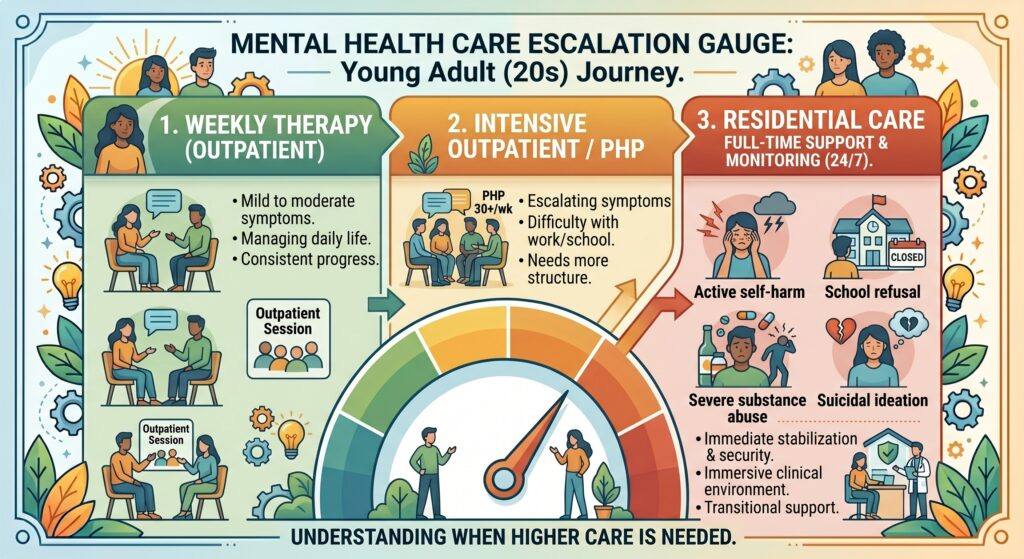
When you seek help, a reputable facility will assess your teen and place them in the least restrictive environment that is medically safe. Here is what the levels of care actually mean:
1. Intensive Outpatient Program (IOP)
- What it is: Your teen attends therapy for roughly 3 hours a day, 3 to 4 days a week, typically after school.
- Who it’s for: Teens who are struggling with moderate to severe depression or anxiety, but who are not actively suicidal and are still functioning well enough to attend their regular high school. It provides a massive clinical safety net without disrupting their living situation.
2. Partial Hospitalization Program (PHP)
- What it is: Often called “Day Treatment.” Your teen attends clinical programming for a full day (usually 6 hours a day, 5 days a week). They sleep safely at home at night.
- Who it’s for: Teens in acute crisis. If your teen is refusing school, freshly out of a hospital stabilization, or engaging in daily self-harm, PHP acts as a temporary medical replacement for high school. (Note: Premium programs include academic coordination so the teen doesn’t fall behind).
3. Residential Treatment Center (RTC)
- What it is: 24/7 immersive clinical and medical care where the teen lives at the facility for 30 to 90 days.
- Who it’s for: Teens who are an immediate danger to themselves, teens who require supervised detox from substances, or teens whose home environment has become too volatile to allow for healing. It is the ultimate “factory reset” for a dysregulated nervous system.
Learn more about how we structure these levels of care on our Programs and Admissions page.
Section 4: What Actually Happens Inside? (The Clinical Work)
Sending your teen to a facility is not about “sending them away to be fixed.” It is about providing them with a specialized environment where they can learn the tools they need to survive their own minds.
At Teen Mental Health Facility, we use Evidence-Based Practices (EBPs). We do not just ask them how their day was; we actively rewire their neural pathways.
- Dialectical Behavior Therapy (DBT): This is critical for teens who self-harm or have explosive rage. We teach them tangible “Distress Tolerance” skills—such as using ice or paced breathing to manually lower their heart rate during a panic attack, stopping the urge to self-destruct.
- Cognitive Behavioral Therapy (CBT): We teach teens how to act as a lawyer in their own minds, catching the “cognitive distortions” (like “I am a failure and no one loves me”) and putting those lies on trial.
- Peer Validation: This is the secret weapon of intensive treatment. When a resistant teenager sits in a group therapy circle with other cool, smart, normal teenagers who say, “Yeah, I have panic attacks too,” the wall of shame shatters. They realize they are not uniquely broken.

Section 5: Overcoming the “Parent Guilt” Trap
If you are hesitating to enroll your child in an intensive program, it is likely because you are caught in the “Parent Guilt” trap.
- “If I send them to a PHP or Residential program, it means I failed as a parent.”
- “They are begging me not to make them go. I can’t bear to see them cry.”
- “What if they fall behind in school?”
We need you to reframe this narrative.
Depression and severe anxiety are neurobiological diseases. If your child had leukemia, you would not feel guilty for taking them to an oncologist. You would not let them skip chemotherapy just because they didn’t want to go. Mental illness requires the exact same level of medical urgency.
Your child’s brain is telling them that treatment won’t work and that they should just hide in their room. They are incapable of making a life-saving medical decision right now. You have to be their prefrontal cortex. Your job is not to keep them happy in the short term; your job is to keep them alive in the long term. Taking the keys to their recovery and making the executive decision to enroll them in a facility is the ultimate, bravest act of parental love.
Section 6: How to Talk to Your Teen About Going
When you make the decision, the conversation will be difficult. Expect resistance. Expect anger.
Do not argue the logic. Validate the emotion and hold the boundary.
- The Script: “I love you more than anything in this world, and my number one job is to keep you safe. Right now, you are not safe. I can see how much pain you are in, and it is my responsibility to get you the best medical care possible. I know you are angry, and I know you don’t want to go to this program. It is okay to be mad at me. But this is not a punishment; it is a rescue mission. We are doing this.”
According to the Child Mind Institute, maintaining calm, unwavering boundaries while acknowledging a teen’s fear is the most effective way to bypass their defensive anger.

Conclusion: You Are Their Anchor
Watching your child drown in a mental health crisis is a terrifying, isolating experience. But you do not have to fight the current alone.
You have done everything you can at home. You have loved them, supported them, and tried to protect them. But when love is not enough to cure a clinical disorder, it is time to bring in the specialists.
A high-quality mental health facility is not the end of your teen’s normal life; it is the bridge that allows them to return to it. It is where they will find their voice, learn how to manage their pain, and rediscover the vibrant, capable person buried underneath the symptoms.
Take a deep breath. Trust your gut. Make the call.
If you are ready to explore admission options and find the exact right level of care for your family, contact the compassionate admissions team at Teen Mental Health Facility today for a 100% free, confidential clinical assessment.
Frequently Asked Questions (FAQs)
Will my teen fall behind academically if they attend a daytime program? No. High-quality PHP and Residential programs include supervised academic hours and dedicated educational liaisons. We coordinate directly with your teen’s home school in California to manage their coursework, secure necessary extensions, and implement 504 plans or IEPs so they stay on track while focusing on their health.
What if they turn 18 while in treatment? If your teen turns 18, they become a legal adult and must consent to continue treatment. Our clinicians work heavily on building “intrinsic motivation” during their stay, so by the time they turn 18, they want to stay and finish the work, rather than feeling forced.
Will my insurance cover an intensive mental health program? Yes. Under the federal Mental Health Parity Act, most major PPO health insurance plans cover intensive clinical care (like PHP, IOP, and Residential) as a medical necessity, treating it the same as a physical hospitalization. Our admissions team handles the entire verification process for free.
Can I visit or speak to my child if they are in a Residential program? Absolutely. We strongly believe in Family Integration. While there may be a brief “blackout” period (typically 48-72 hours) upon initial admission to allow the teen to settle in and detach from outside triggers, family therapy, phone calls, and visiting hours are a core component of the healing process.